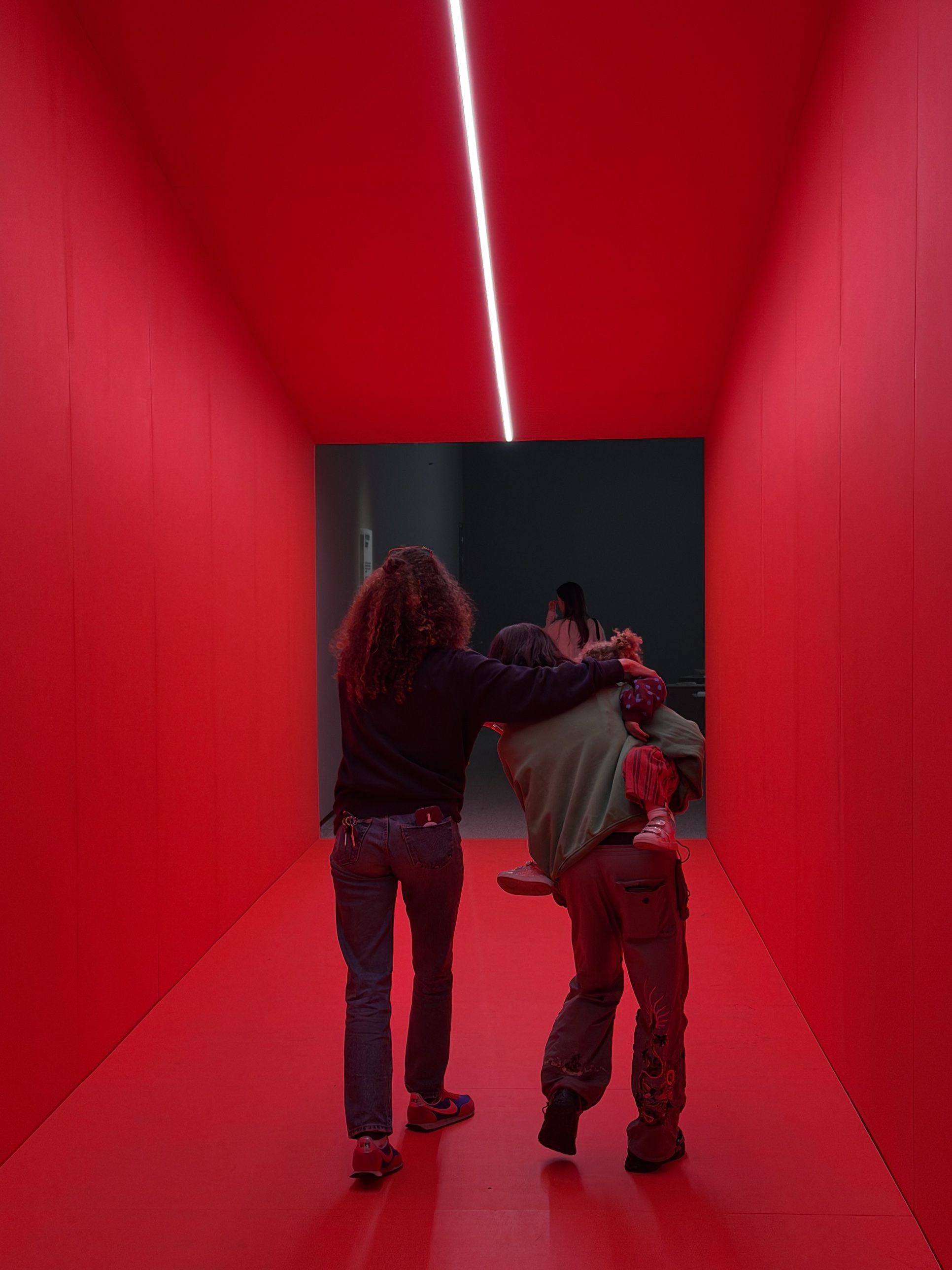
At Es Devlin's Other Worlds, the most revealing thing in the building was not on the walls — it was the quiet transfer of cultural codes from adults to children, one label at a time.
I went to Es Devlin's Other Worlds at the Design Museum, and the world that stayed with me was not one she had made. It was the room — who moved through it easily, who paused, and who was being taught how to look.
Devlin has a phrase for what happens when an audience gathers: a 'temporary society,' strangers briefly made into one body by a shared thing in front of them. The exhibition is built on it. But a society is never only a gathering. It has rules, habits, people who already know how to move inside it, and people who are still learning. That was the exhibition I watched.
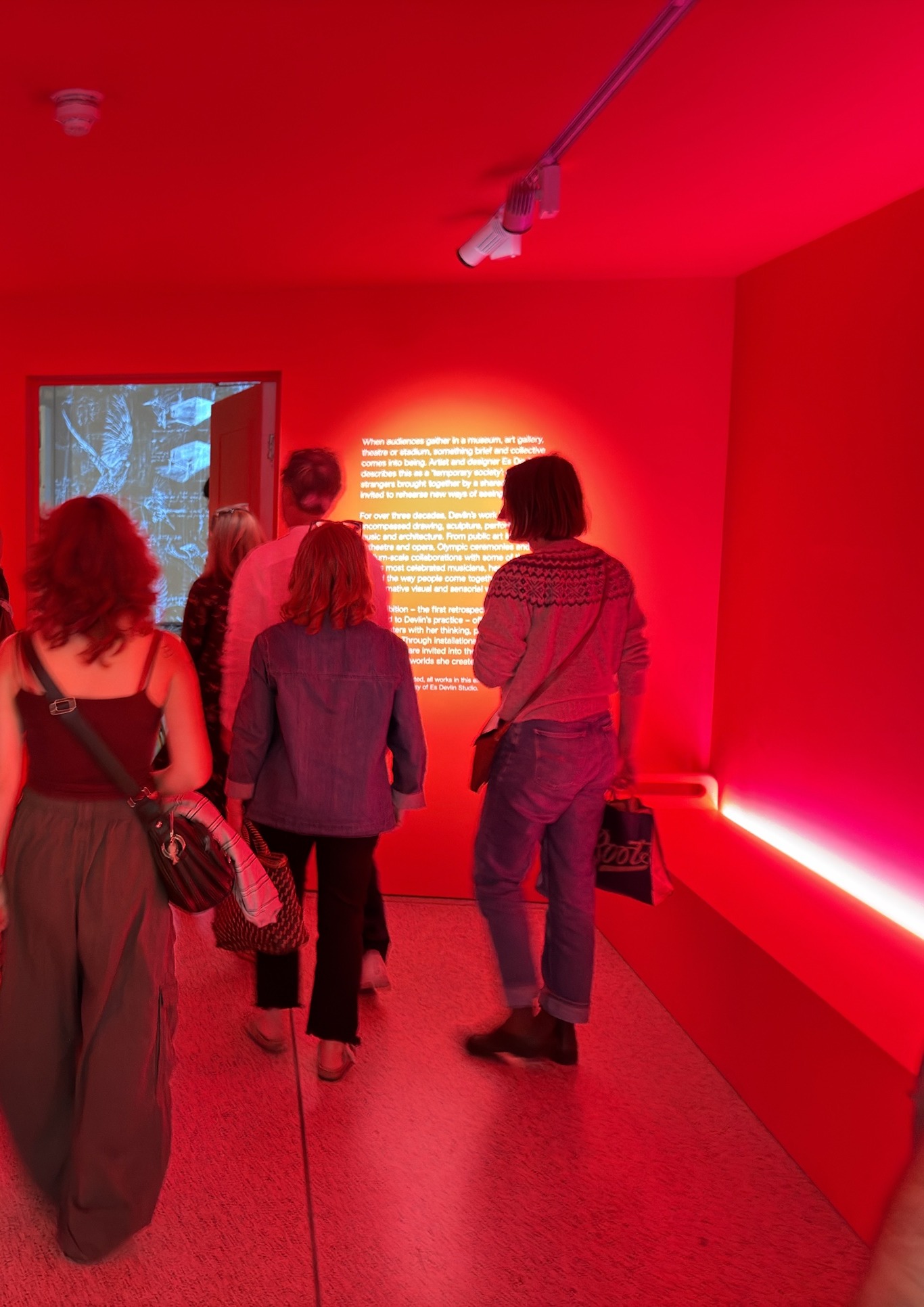
It begins like theatre. You wait in a red holding room for the next timed entry, held back until the doors open — audience before curtain, body before permission. Then the first room refuses the finished object and shows the making instead: canvas and paint, pencils, études, models, photographs, a film moving through the works and the life behind them. Before you are shown the result, you are taught the process. Devlin came out of theatre, and the exhibition remembers it: it does not simply display work, it stages the viewer.
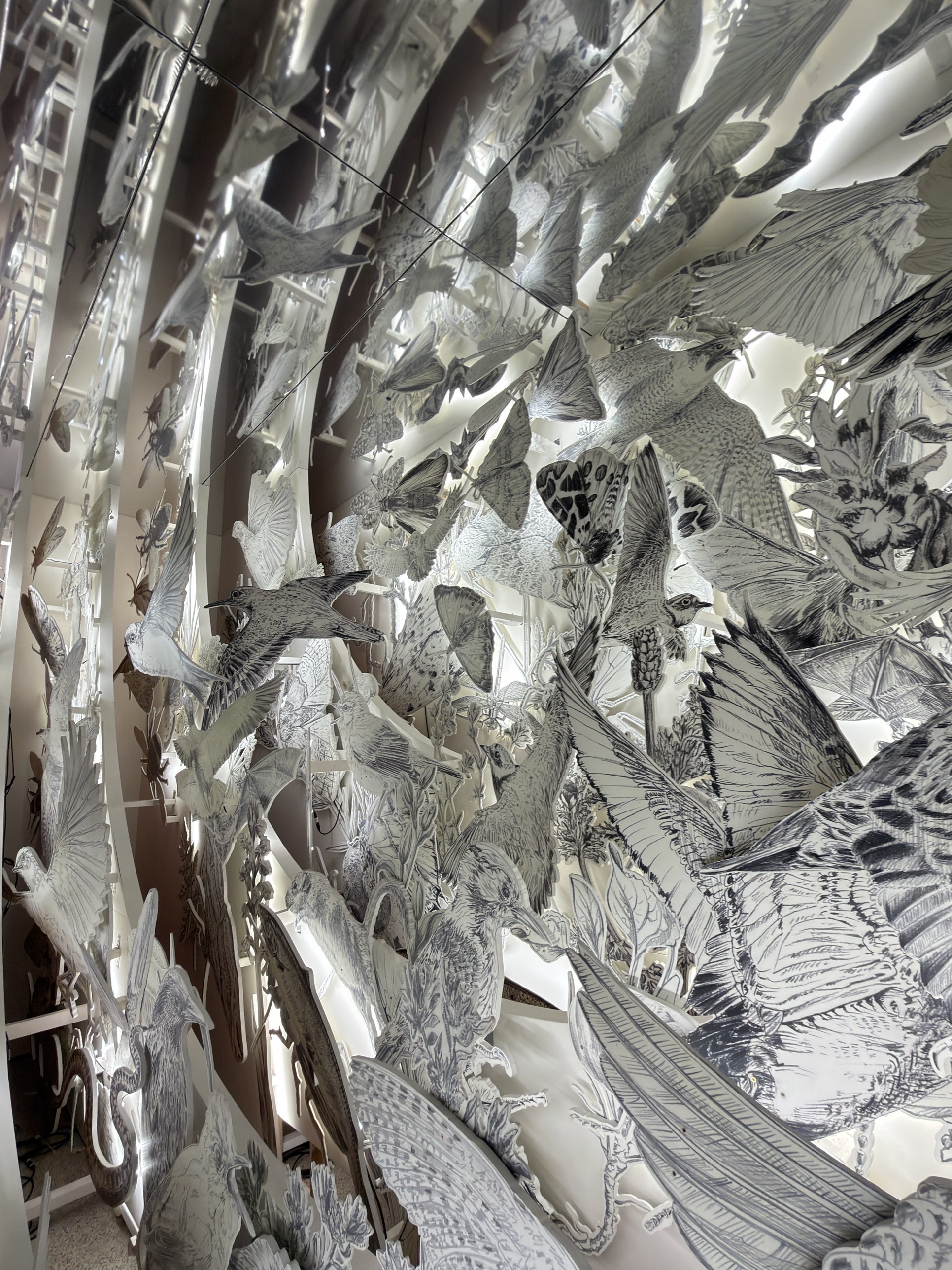
Then the wall opens. At the end of the film the screen itself parts, and you step into Come Home Again, a circular field of drawn birds, insects and plants rising around you — London's endangered species remade as an environment. It is not hung for inspection. You are moved into it. By now the show has taught its first lesson: looking is not neutral. It is choreographed.
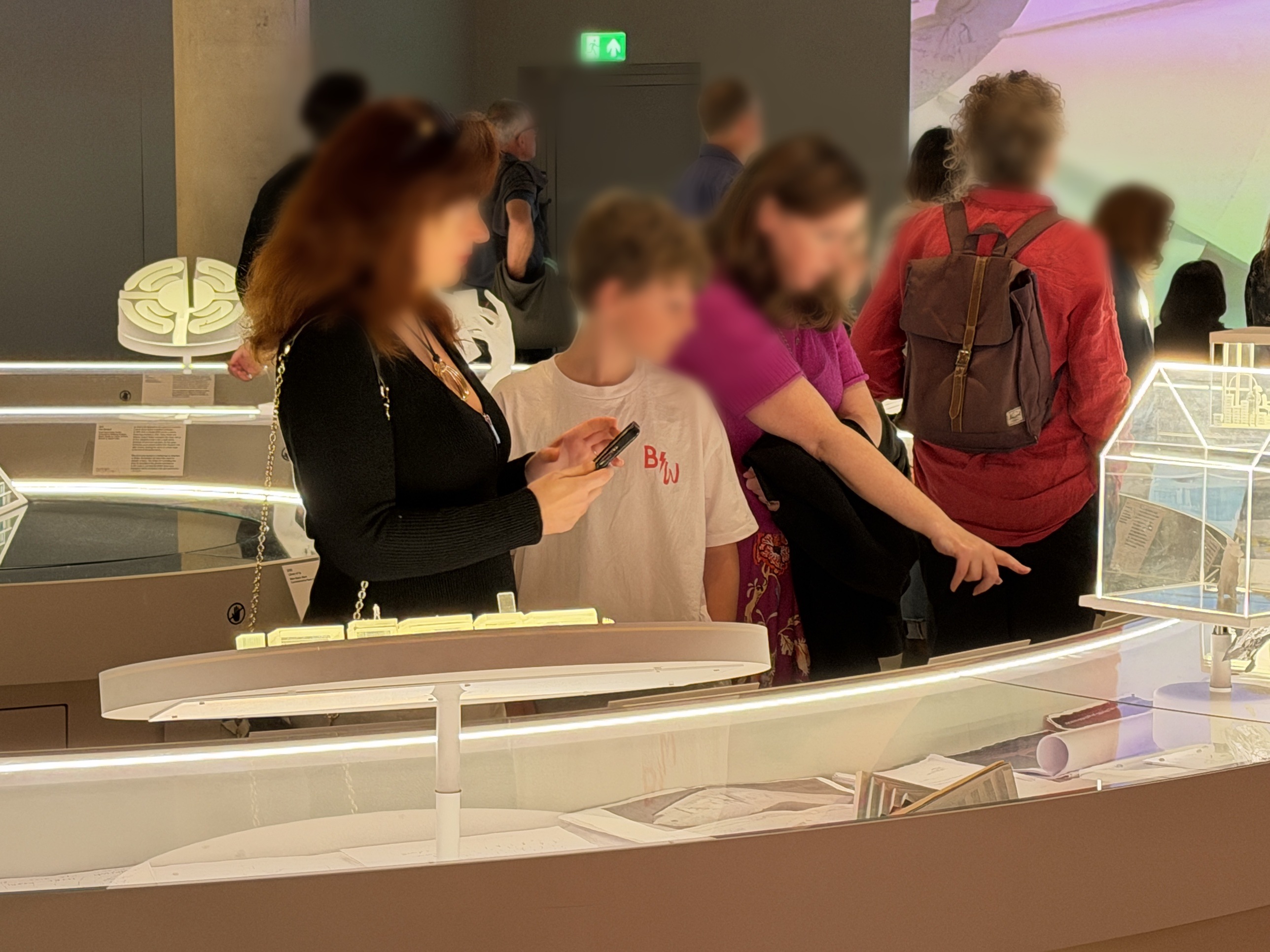
The next hall makes that explicit. Each work is traced from first sketch to finished form — studies, models, captions, the evidence of decisions made before spectacle. It could have been an ordinary display of process. What made it sharp was not the material on the walls but the behaviour around it.
Families had come with children — ten, twelve, thirteen. The children were the ones who stopped. They pointed. What is this? they asked, and the parents bent to the labels and read them out. It looked ordinary. It was not. This was cultural initiation, happening in public and without ceremony: one generation passing on not only information but a way of standing in a museum — how to slow down, how to read a caption, how to tie a sketch to a finished work, how to treat process itself as something that carries value. The children were not only learning about Es Devlin. They were learning how to become the kind of person for whom an exhibition like this is readable.
That is a different subject from the one on the walls.
Museums measure access in tickets, opening hours and step-free entrances. But access does not end at the door. You can stand inside the room and still not hold the code that opens it. Some arrive already fluent — they read the sequence without being told: sketch, model, commission, installation, archive; they know the unfinished can say more than the finished. Others need it translated in real time. Here, the translators were parents.
You reach the last space through another red corridor, into a room holding a slowly turning library on a mirrored floor, its books ranked by colour. Around it sits a ring of low boxes that look, at a glance, like seats. They are not. Each holds a single open book. The small confusion is the point: you think the room has made a place for your body, then see it has made a place for the book. Rest is withheld; reading is centred. The room is arranged not around comfort but around attention.
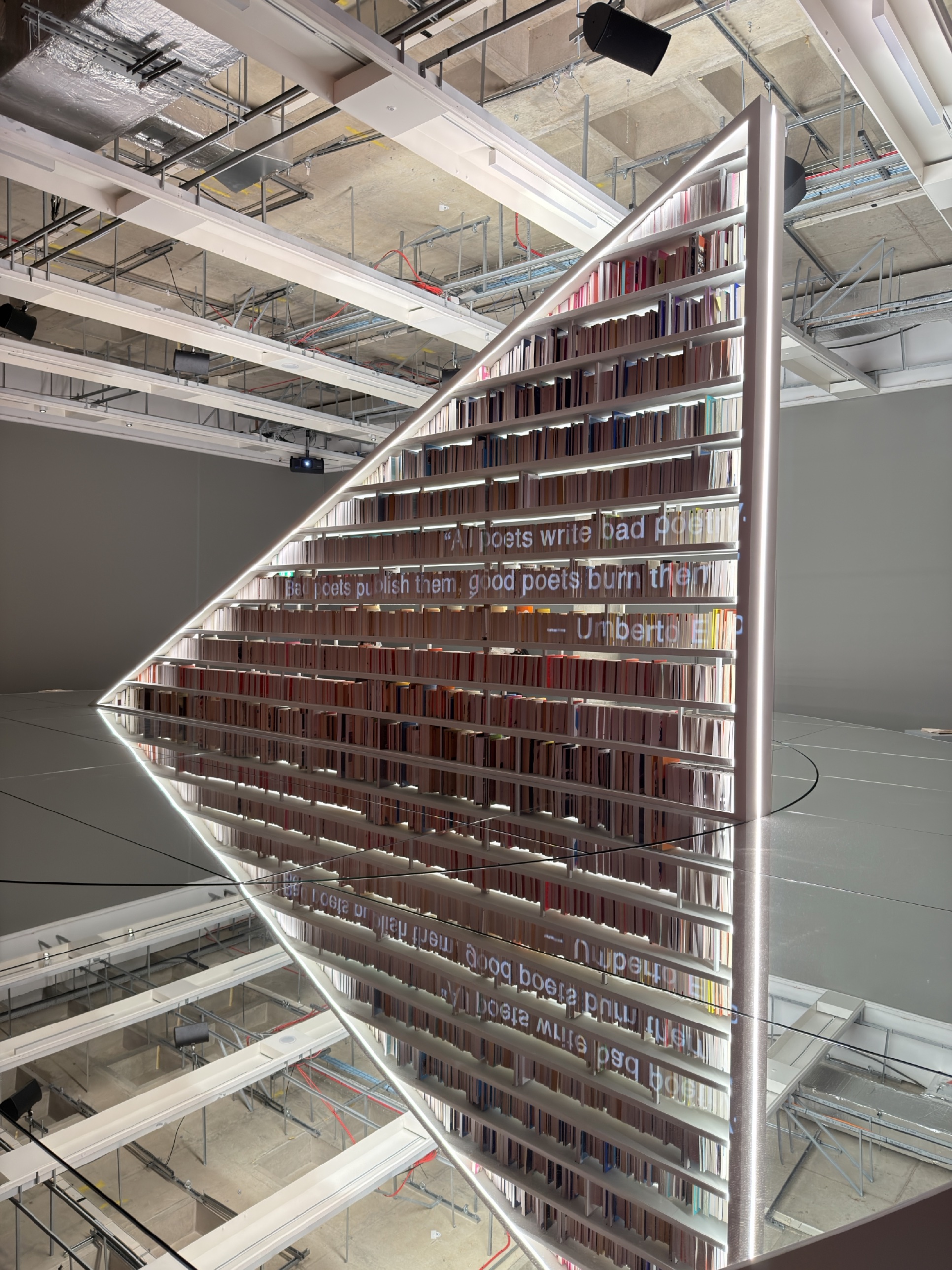
It is precise staging, and it repeats the show's deeper structure. The visitor is constantly positioned — held, released, surrounded, redirected, corrected — asked not only to look but to learn the correct relation to looking. Which is why the most important audience in the building may not be the adults who already understood it, but the children being brought into that understanding.
Devlin's worlds are generous in scale: they surround, reflect, rotate, open and close. But the most durable world in the museum was smaller, and harder to photograph — the one in which cultural knowledge quietly reproduces itself. A parent reads. A child listens. A label becomes a lesson. A room becomes a school for attention.
The other worlds were on the walls.
The code was in the room.
Related: The People in Front of the Glass — Schiaparelli at the V&A →
Es Devlin: Other Worlds, the Design Museum, London, 2 October 2026 – 4 April 2027. Visited October 2026.
Written and photographed by Reza Gheibi.