
A field note from the Emirates Great Britain Sail Grand Prix in Portsmouth, where a £141.04 ticket graded its own visibility as Normal — and where the wristband revealed the difference between comfort and proximity.
The race was on the water. The first thing that organised the day was on the wrist.
I went to the Emirates Great Britain Sail Grand Prix at Southsea Common in Portsmouth on Sunday 26 July 2026, alone, on the final day. I had not followed SailGP before. I did not know the boats, the crews, or the scoring structure in any serious way. I went to see how a global sponsor shapes a day on the English south coast, and what a premium ticket makes available to someone arriving without prior knowledge.
The ticket recorded the transaction clearly: Adult, Race Stadium Entrance, Block B1, Row L, Seat 25. Price £130.00. Fees £11.04. Total £141.04. Gates at 14:00. Two lines of policy followed: no entry once the final race begins, and no re-entry once you leave.
It also recorded something I did not expect a ticket to state so directly.
Visibility: Normal.
 Reza Gheibi
The object that replaced the ticket
The instruction was simple: scan the ticket, then collect an RFID wristband from the welcome staff immediately.
So the ticket was not, in practice, the object that organised the day. It was the object I exchanged for the one that did. After the gate, access moved from paper to wrist. The entrance I used, what I could collect, what was included, and where I could move were no longer read from the ticket. They were read from the band.
The wristband was the real ticket. That is not a metaphor. It was the operating system.
It was also a wallet. The tier is sold as Premium Waterfront Grandstand at £130 for the day, and what it loads onto the band is credit: one meal and three drinks, cashless, spent by holding your wrist out. I used a sandwich and two of them. The comfort was supplied slightly past the point of need.
Through the dedicated Emirates entrance, the band also carried a soft Emirates-branded seat pad. None of it had to be bought separately. It arrived inside the price of the ticket, attached to the wrist, and that is the grammar of this tier: a better way in, a few objects of comfort, and a clearer sense of being handled.
Not fully hosted. Not ordinary entry either. Something in between.
The English surface
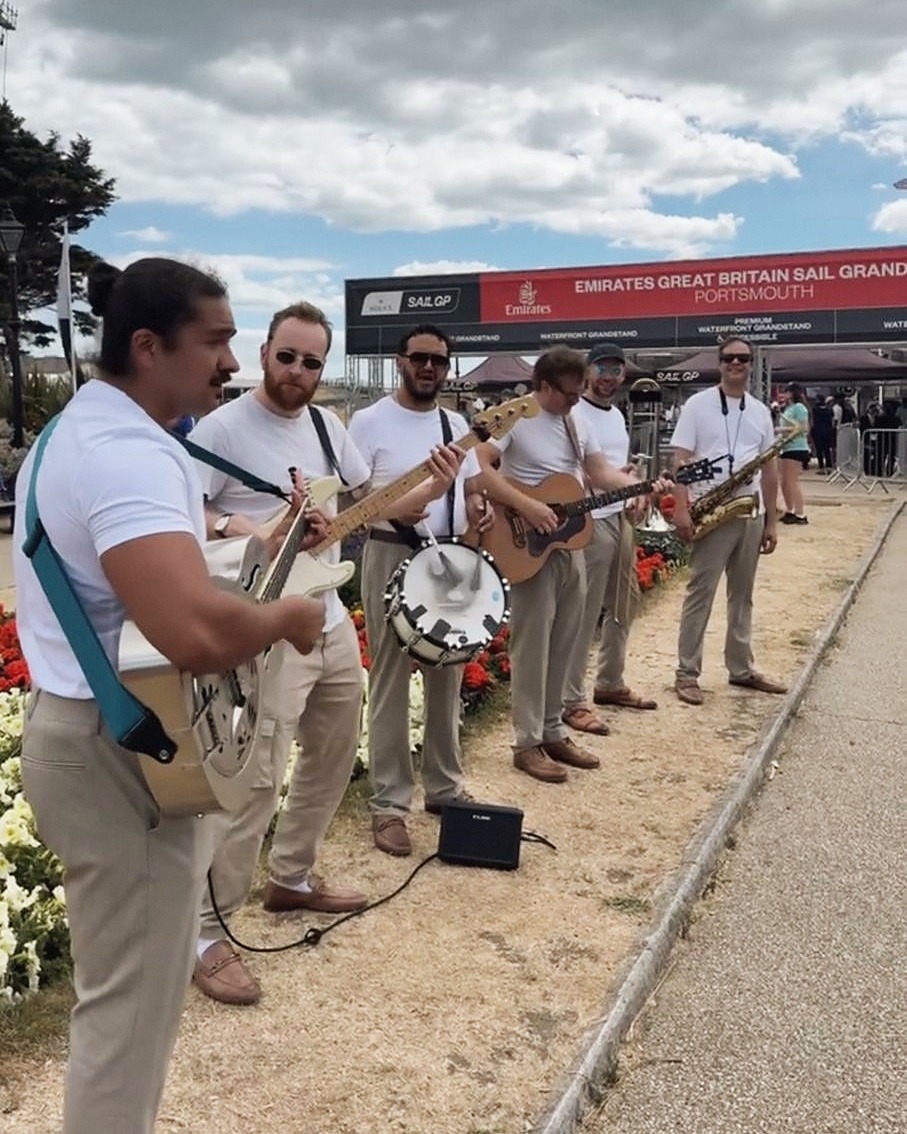
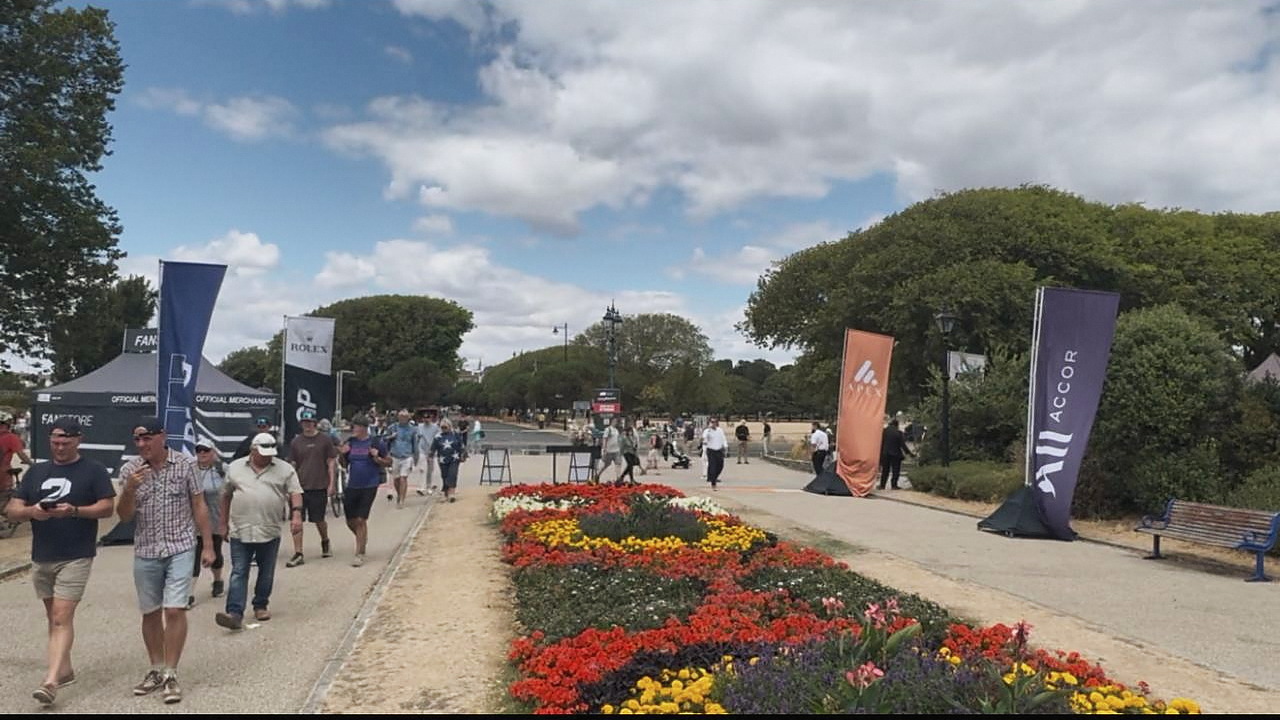
The approach was well made. Flowers near the entrance. Music along the route. One group had a South American sound; another felt more recognisably English. There were cafés, temporary bars, visitor activities and small competitions. A presenter moved through the crowd, speaking to people directly and making material out of the day as it unfolded.
 Reza Gheibi
The atmosphere was not cold or corporate. It was bright, English, open, and easy to like. Families were there. Groups were there. Many people seemed attached to the British team, or at least to the idea of seeing Britain do well at home.
That mattered. Whatever else SailGP is as a global property, Portsmouth did not feel like a sponsor installation dropped onto a shoreline. The event understood how to make scale feel local.
But a surface is not false simply because it is constructed. It is doing a job.
What the sponsor touched
Emirates was not only visible at Portsmouth. It held the name of the event, the name of the home team, and the airline category around the competition. But the part I noticed most was not the naming. It was the physical form of the sponsorship.
I entered through it. I wore it. I ate from it. I sat on it.
Emirates was not only seen; it was handled.
This is more interesting than a logo. A logo asks to be noticed. A system asks to be used. At Portsmouth, the sponsorship was not just above the day, placed on signage and screens. It was inside the mechanics of arrival, seating, comfort and entitlement.
The brand did not merely say it was present. It made presence operational.
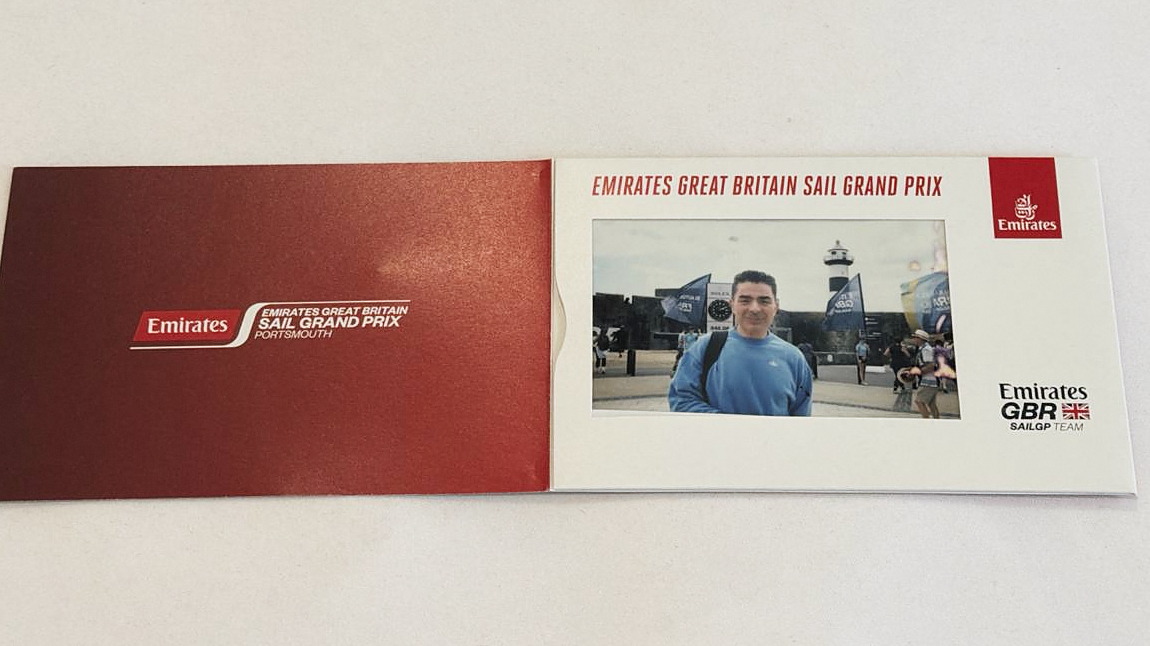
At the Emirates entrance they photographed me. The print was ready in a moment and came back inside a folded card — Emirates Great Britain Sail Grand Prix, Portsmouth on the cover, the Emirates GBR SailGP Team lockup beside the picture. In the photograph I am standing in the fan zone with flags behind me, some way from the water.
 Reza Gheibi
I had not been able to photograph the centre. The perimeter photographed me, and handed it back in its own wallet.
The keepsake of the day is a picture of where I was allowed to stand. Everything I photographed that afternoon was the perimeter: the approach, the band, the crowd, the dust. I have no picture of the podium, the champagne, or the boats at a legible distance. The one image of the centre that I brought home is the one Emirates made, of me, at the gate.
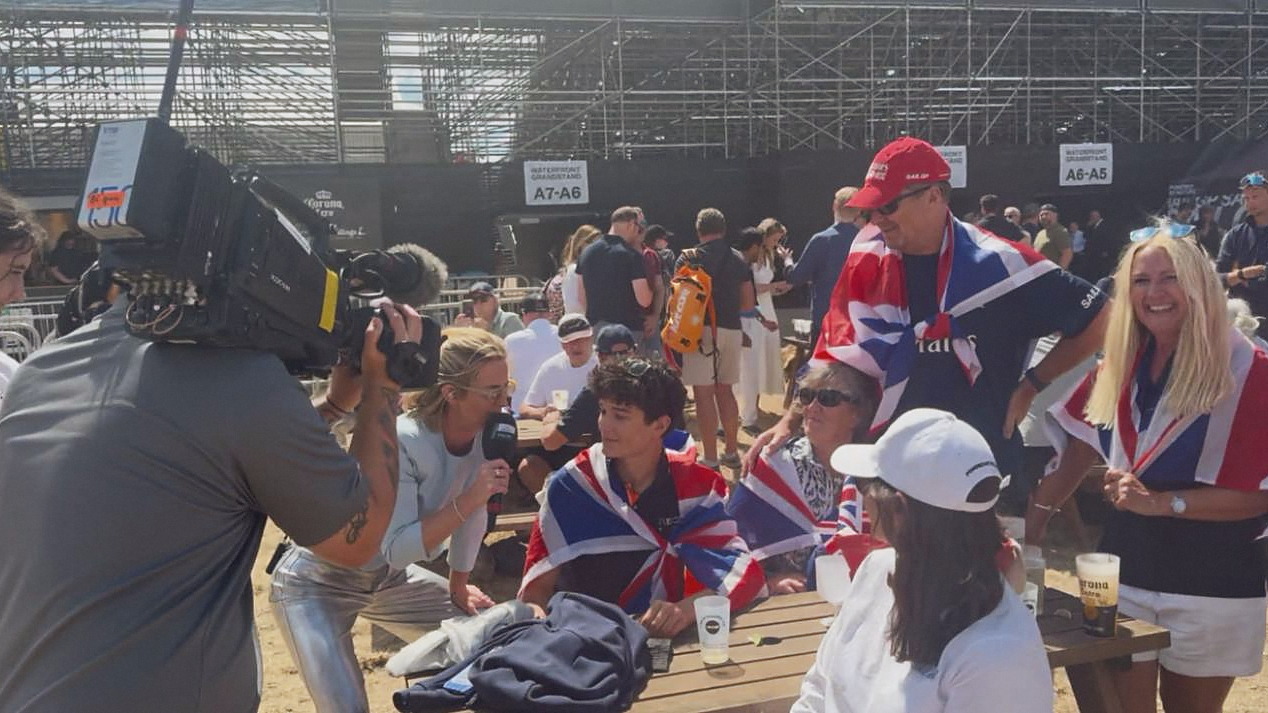
The event made images of its spectators at two scales that afternoon: a broadcast crew working the picnic tables, and a print pressed into your hand at the gate. Both pointed outward, away from the water.
Still, every one of those objects operated on comfort. Not one of them moved me into the centre.
Normal visibility
The route to the stands was controlled and clear. My view from Block B1 was reasonable. A good deal of the racing was watched on the large screen, as it was for many people around me. That was not necessarily a failure of the ticket. The boats race offshore; distance is part of the sport’s shape.
But the event did not sell only sightlines. It sold degrees of access, and it published the ladder.
Waterfront Grandstand, £75 for the day. Premium Waterfront Grandstand — mine — £130. VELA Beach Club, £245, with shaded viewing, complimentary food and drink and expedited entry. VELA Privé, £500, all-inclusive, private waterfront lounge, dedicated staff, minimum ten people per booking.
These were not abstract categories. One of those rooms sat beside me. It had its own entrance, its tables, its service, its positioning. It faced the podium.
So the distance I want to describe was not simple distance. I could see the prize-giving, the champagne, the music and the DJ from only a few metres away. What separated me from them was not the length of a shoreline. It was a boundary.
And the boundary was read from the wrist.
I can describe the arrangement. I cannot describe what those guests came for, or what was said inside. That would be invention. What was legible from beside it was position. And position was the product.
The ticket had already told me this in a field I had not thought to read. Not restricted. Not obstructed. Not poor. Normal.
A grade, printed in a box, on the same document that carried a QR code inviting me to enter a draw to win the signed celebratory champagne bottle.
I could see the champagne. I could enter a competition to be sent some.
That is not irony. It is design.
The dust
Reza GheibiThe ground on the way to the stands was dry. When the wind lifted, the dust came up with it. It went into faces, hair and clothes, across tiers.
The hierarchy was precise. The ground was not.
I record this because it was one of the only elements of the day that seemed evenly distributed. A premium wristband did not keep the dust down. A piece that omitted it would be describing a brochure, not a visit.
It also helped the day stay human. The event had a sophisticated structure of access, branding and hospitality. But it still took place on a shoreline, in wind, on ground that had not been fully disciplined into the image.
That is often where reality enters these things. Not as collapse. As texture.
The result
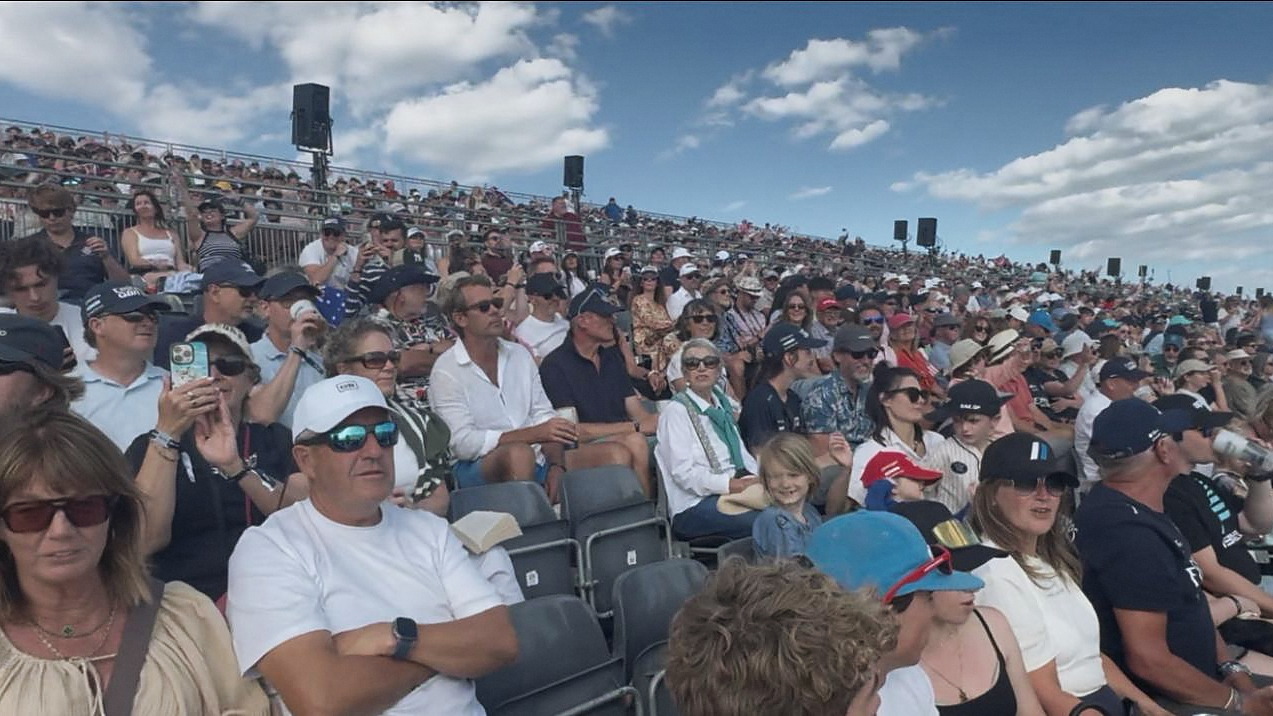
The Emirates Great Britain team finished eleventh, out of the points, at its home event, in front of a full shoreline. The Grand Prix was won by Los Gallos, ahead of Artemis and NorthStar.
 Reza Gheibi
The disappointment around me was real and audible. But it did not narrow the crowd.
That was one of the more revealing qualities of the day, and something I had also noticed at show jumping in Chelsea. Spectators could move quickly from national preference to sporting recognition. People wanted Britain to do well. But they still applauded speed, control, risk and a beautiful performance when it came from elsewhere.
The attachment was real. It was not tribal enough to block admiration.
 Reza Gheibi
That matters. It keeps the event from becoming only a branded environment or a hierarchy of access. The sport was still able to command recognition on its own terms. People did not appear to be watching only because of the sponsor, the food, the band, the view, or the hospitality structure. Many were watching because the performance itself could still take hold of the crowd.
The airline held the name of the race, the name of the boat, and the airline category around the competition. It had arranged the entrance, the wristband, the food and the seat pad.
It had not arranged the water.
That is not a criticism of the sponsorship. It is a description of its limit. Sponsorship at this scale can organise almost everything a spectator touches, and much of what frames what they see — but not the contest on the water itself.
What became legible
I left wanting to have bought the ticket in front of mine.
I record that as a result rather than a feeling. The effect the day had on me was to make the next purchase suggest itself — not by hiding the race, and not by making the ordinary experience poor, but by leaving the centre close enough to see while entry to it stayed a property of the band.
Premium improved the day. The podium still faced somewhere else.
That distinction is important. My ticket gave me comfort, structure and a better arrival. It did not give me the centre. The centre was visible from where I stood, which made the difference clearer, not less clear.
It also had a price, published in advance: £245 to sit in it, or £500 in a room that could not be booked by fewer than ten people. One of the two spaces in front of me was not for sale to a person attending alone, at any price.
Modern sport of this kind does not sell one experience. It sells calibrated distances from the centre — and at Portsmouth the calibration was not spatial. I was already near where I wanted to be. The hierarchy was in what I was wearing.
One visit cannot establish whether the front rooms delivered what they appeared to promise, or whether the day converted anyone into a returning spectator. It showed something smaller, and more useful.
The race was public. The hierarchy was not.
At Portsmouth, the water held the race. The wristband held the hierarchy.
Sold, bought, unavailable
Sold. Block B1, Row L, Seat 25 — Premium Waterfront Grandstand at £130.00 plus £11.04 in fees, £141.04 in total. Visibility graded Normal on the ticket. Food and drink credit included.
Bought. A dedicated Emirates entrance, an RFID wristband carrying credit for a meal and three drinks, a branded seat pad, a seat beside the hospitality area, and a full day inside a well-made public event.
Unavailable. Not proximity. I had that. Entry. The podium, the prize-giving, the champagne and the DJ were a few metres away and closed to my band; the room beside me was published at £245, and the one beyond it at £500 with a minimum of ten people, which is to say it was not available to me at all. Also unavailable, and not for sale to anyone that weekend: the result. The team the airline had named finished eleventh at home.
How we know
This is a first-person account of the final day of the Emirates Great Britain Sail Grand Prix in Portsmouth, attended independently on a Premium Waterfront Grandstand ticket.
The dedicated entrance, the wristband and what was taken with it, the seat pad, the music and floral arrangement along the approach, the presenter working the crowd, the dust, the screens, the position of the hospitality area beside Block B1 and its separate entrance, and the mood of the crowd are what the author saw and heard. All photographs are the author’s own. Six were taken at Southsea Common on 26 July 2026; the photograph of the keepsake was taken later, indoors, of the object itself. All were cropped to a common set of aspect ratios and colour graded as a set. Nothing has been added, removed, moved or synthesised within any frame.
The date, gate time, access type, block, row, seat, the £130.00 price, the £11.04 fees, the £141.04 total, the “Visibility: Normal” grading, the instruction to collect an RFID wristband on scanning, the re-entry policy, the named zones on the site map and the champagne prize draw are taken from the author’s own ticket, issued 17 July 2026.
The ticket tiers and their published prices and inclusions are taken from SailGP’s Portsmouth ticketing information, as published at the time of writing.
Emirates’ sponsorship positions — Title Partner of the Emirates Great Britain Sail Grand Prix Portsmouth, Global Partner and Exclusive Airline Partner of SailGP, and Naming Partner of the Emirates Great Britain SailGP Team — are taken from Emirates’ own announcement, which also sets the event dates as 25–26 July 2026. The Polaroid keepsake and the branded seat cushions are among the activations named in that announcement, alongside premium hospitality and Tech Base tours.
The finishing order and the British team’s eleventh place are taken from SailGP’s own event recap.
What other attendees paid, what was said or intended inside the hospitality areas, and whether the event produced returning spectators, remain open.
Disclosure. ELIN attended independently. The ticket was bought at the author’s own cost, with no hospitality, accreditation or complimentary access. As of publication, the author had no commercial, sponsorship, client or employment relationship with Emirates, SailGP, the Great Britain SailGP Team, the event organisers or the performers.