ELIN reads an opening night at EDEN on New Bond Street: a room that titles itself on the wall, hands you a brush, and gives you — free — a print with your own name written on it. The priced objects were the impersonal ones.
A gallery two streets away shows you nothing and explains less. This one explains everything, stays open until nine, seven days a week, and sends you home with your own name written on a print — for nothing. Both are selling. They are not selling the same thing, and the difference is not taste.
At the door
The first thing that reaches you is popcorn.
It is being made at the entrance, a few feet inside the glass, and the machine is working. Each time the door opens the outside air pushes the smell inward, where it meets the perfume. New Bond Street at seven in the evening is a corridor of very deliberate scent, and for the length of the threshold it is cut with a fairground. Inside, guests carry paper cartons and eat standing up, which does to a white room what a carton of popcorn always does: it turns it, briefly, into a cinema foyer.
My first reaction was that someone had put it in the wrong place. I think that reaction was wrong, or at least incomplete. The popcorn is doing a job. It is the most efficient signal available that this is not a room where you will be made to feel stupid — no appointment, no silence, no one deciding whether you are worth a greeting. A gallery that wants people to walk in from the street has to say so before they are all the way in, and smell says it faster than a sign. I came in expecting a gallery and felt friction. The visitor EDEN is built for comes in expecting a shop and feels welcome. Both of us are reading the same signal correctly.
One detail stayed with me. The people making and handing out the popcorn behaved differently from the hosts working the room — warmer, less rehearsed, and visibly on a different job. The room had been staged with real care, and that was the seam where the staging showed.
One piece of timing belongs on the record. This was the evening of Wednesday 14 October, the middle of Frieze week — the one week in the year when London is full of people who buy art and every room in Mayfair is competing for the same walk-in. I am noting when the door opened, not reading a motive into it.
The wall that explains itself
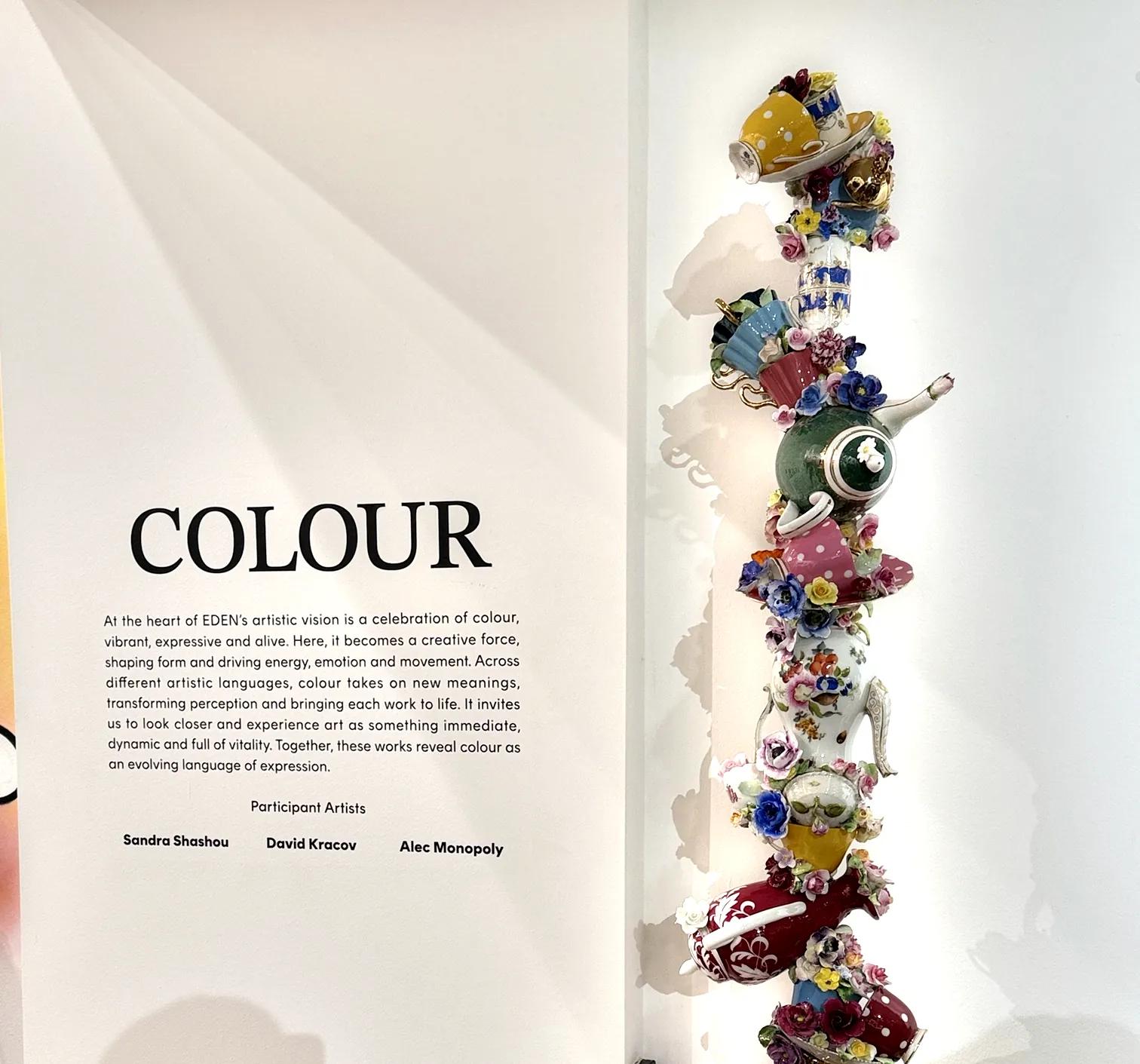
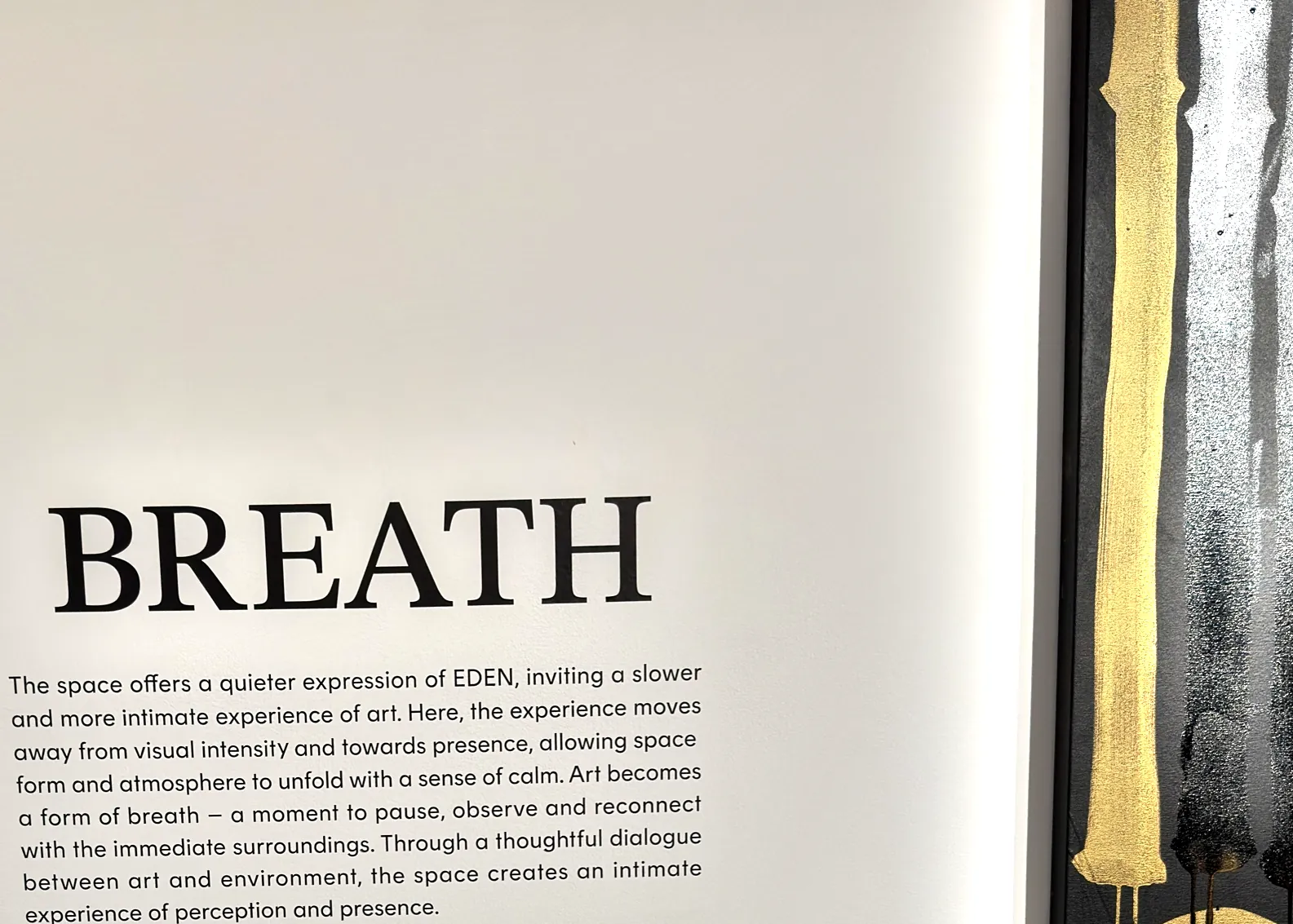
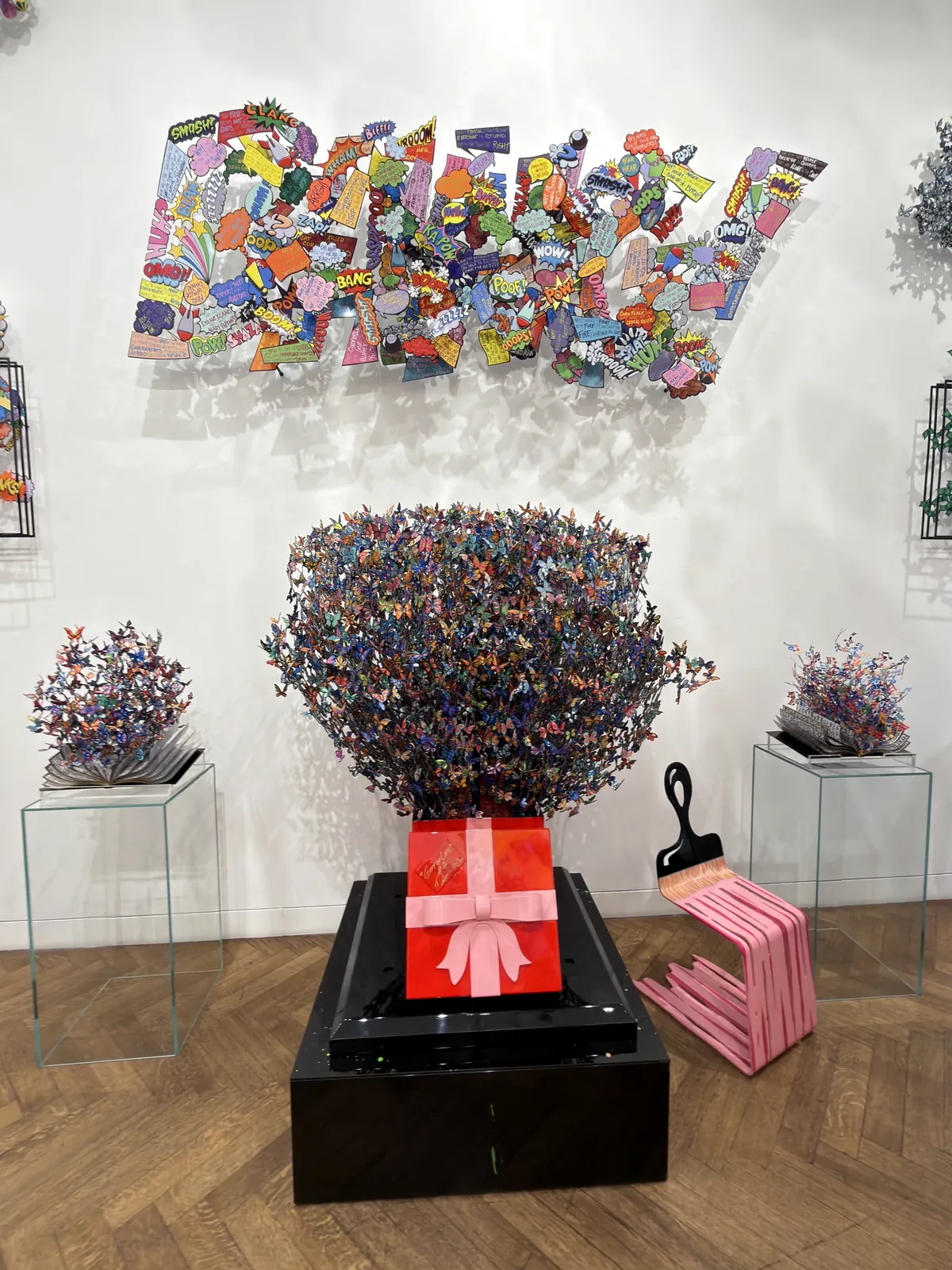
The rooms are titled. One wall carries the word COLOUR in serif capitals, a short paragraph underneath about colour as a creative force, and then three names: Sandra Shashou, David Kracov, Alec Monopoly. Another carries BREATH, with a paragraph about a quieter register, a slower experience, presence rather than visual intensity. Plinths carry small brass plates with the artist's name on them.
This is worth stopping on, because it is the opposite of what the hierarchy predicts.
A week later, two streets away, I stood in a room of large photographs in a gallery nobody would call commercial in that tone. There were no labels on the wall — no titles, no dates, no dimensions — and nobody at the desk looked up when anyone came in or went out. I want to be exact about what that is evidence of, because it is less than it first appears. It is one room, on one morning. The building turns out to have two separate spaces with separate street entrances, and I found only one of them. The gallery may well hand a checklist to anyone who asks, as most do. What I can say is that the information was not on the wall, and that I would have had to know to ask for it.
Set that beside this wall text and a question forms, which I would rather leave as a question than answer from two visits. A room selling to buyers who arrive already briefed does not need to explain itself on a wall; the briefing travels by other means — a conversation, a price list handed over on request, the adviser a visitor brought with them. A room selling to whoever happens to be on New Bond Street at nine in the evening has to do the briefing itself, in advance, for free. That reading fits what I saw in both places. It is not the only reading that would, and one morning in one room and one evening in another are not a study of two businesses.
So the wall text is not a sign of a lesser gallery. It is a sign of a wider door.
The wall you are handed
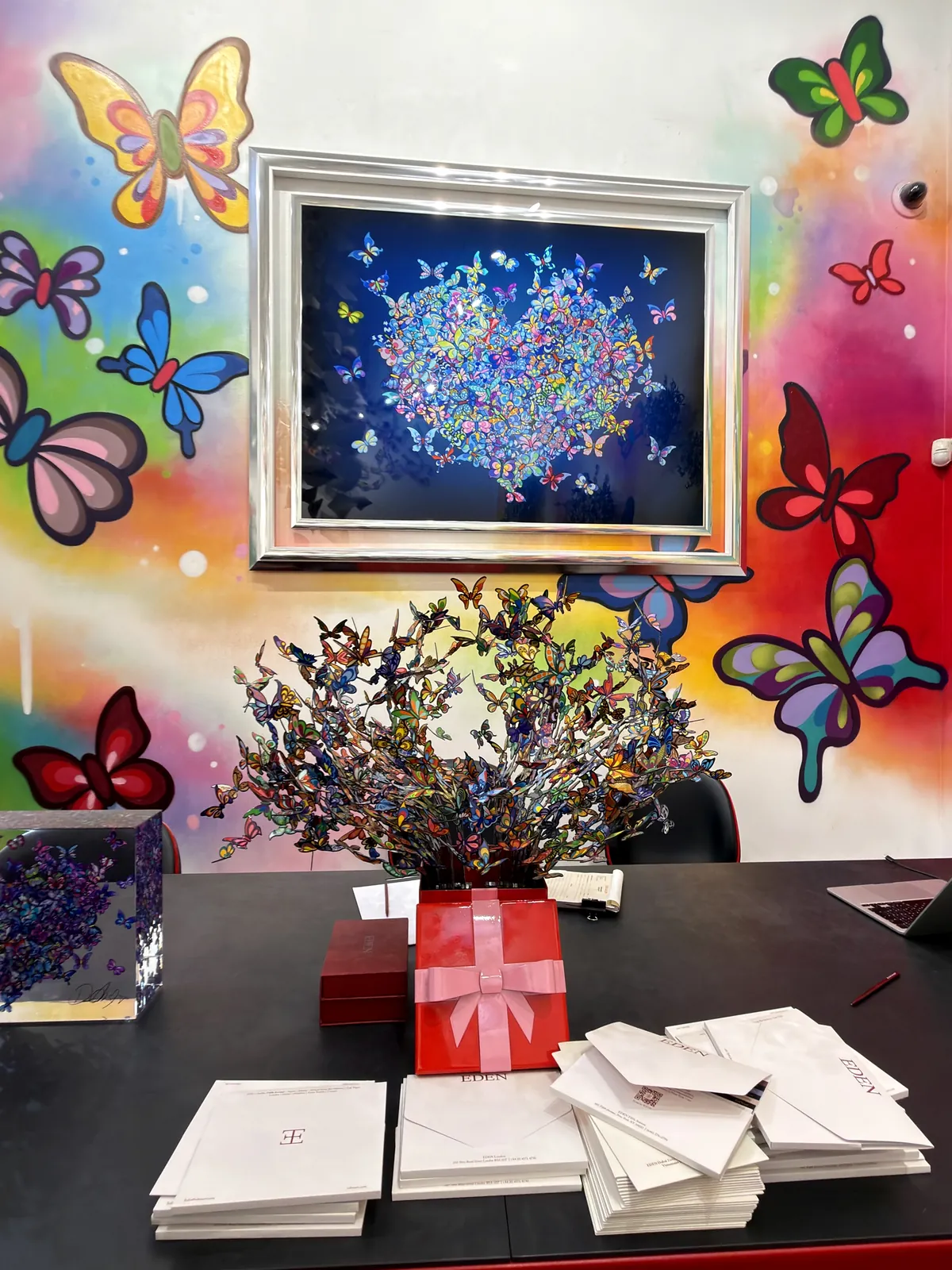
Along one wall, butterflies had been drawn in outline over a sprayed ground of pink, orange and violet, and visitors were colouring them in. Children and adults, people in their twenties and people a long way past it, each taking a butterfly and filling it in however they liked. It was one of the evening's attractions, and the attraction was not the mural. It was having a hand in it.
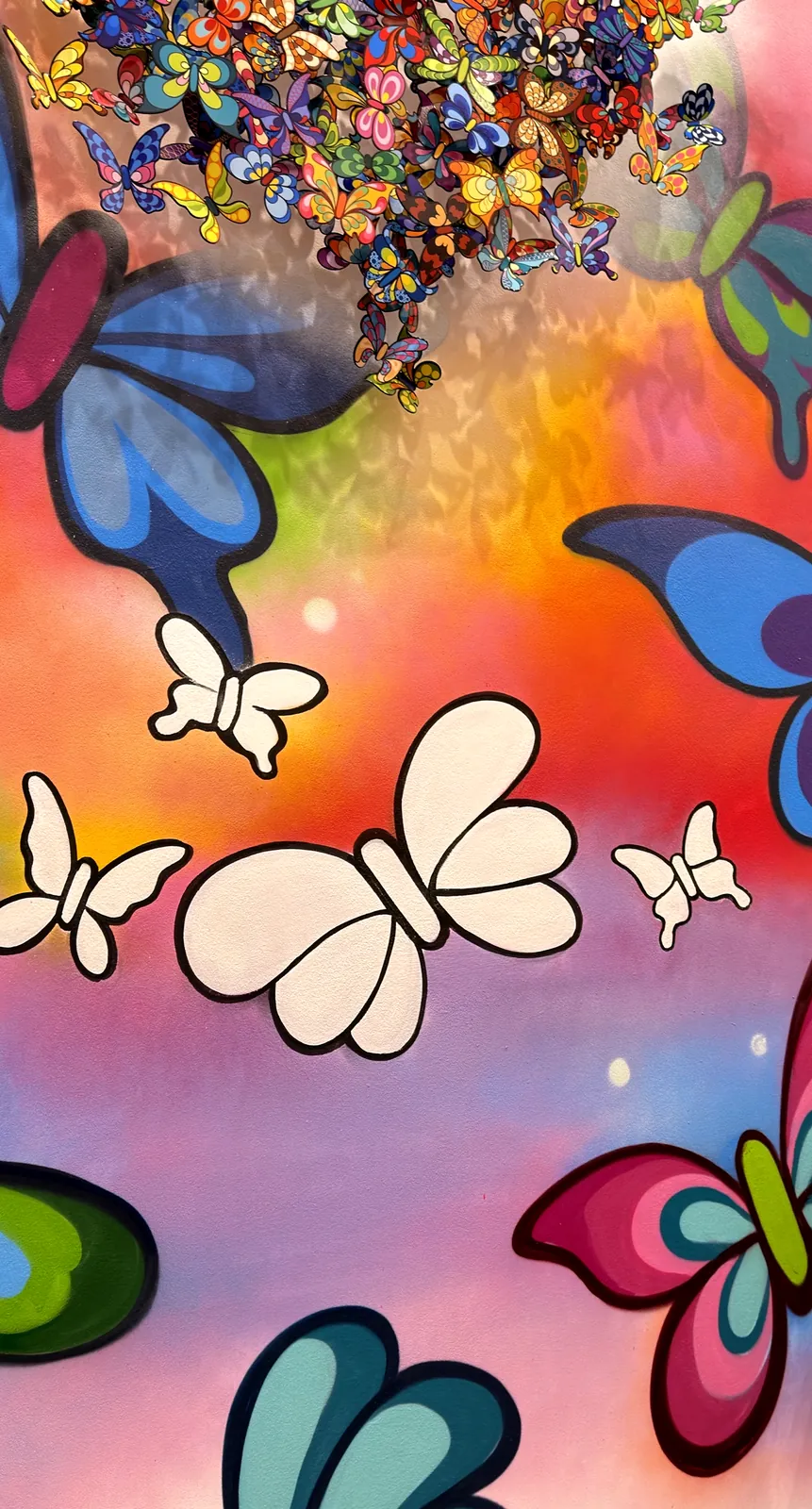
This is the wall text one step further. The paragraph tells you how to look; the mural lets you do something. Neither asks anything difficult of you — the composition is given, the outlines are drawn, the colours are laid out, and what you supply is a choice inside somebody else's lines.
Worth saying plainly, because it is the same structure that left me cold elsewhere in the building: an image given, very little labour required. Here it works, and it works because nobody is selling you the labour. The butterfly you paint is not for sale. It is an evening, and an evening is allowed to be easy.
What is for sale
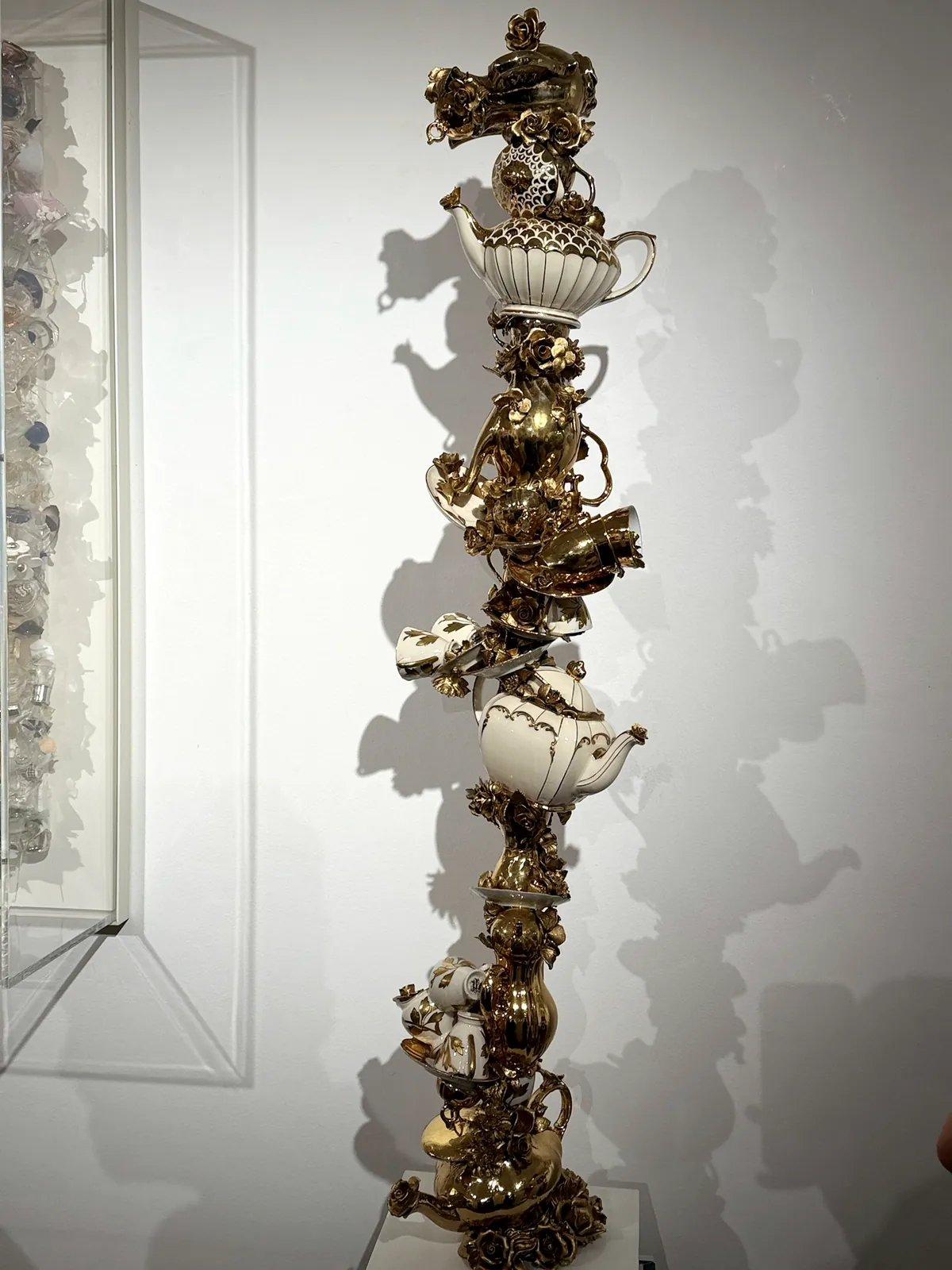
The strongest objects in the building are the broken ones. A cube of shattered Wedgwood jasperware, blue and white, the sprigged figures and laurel borders snapped mid-garland and packed into a solid block, sits in a vitrine where the glass puts your own reflection over the damage. Nearby, towers of teapots, cups and saucers are stacked and fused into columns, gilded in one version and in full colour in another, each topped with porcelain roses. Hearts made of the same material hang on the wall. The plinth plates give the artist as Sandra Shashou.
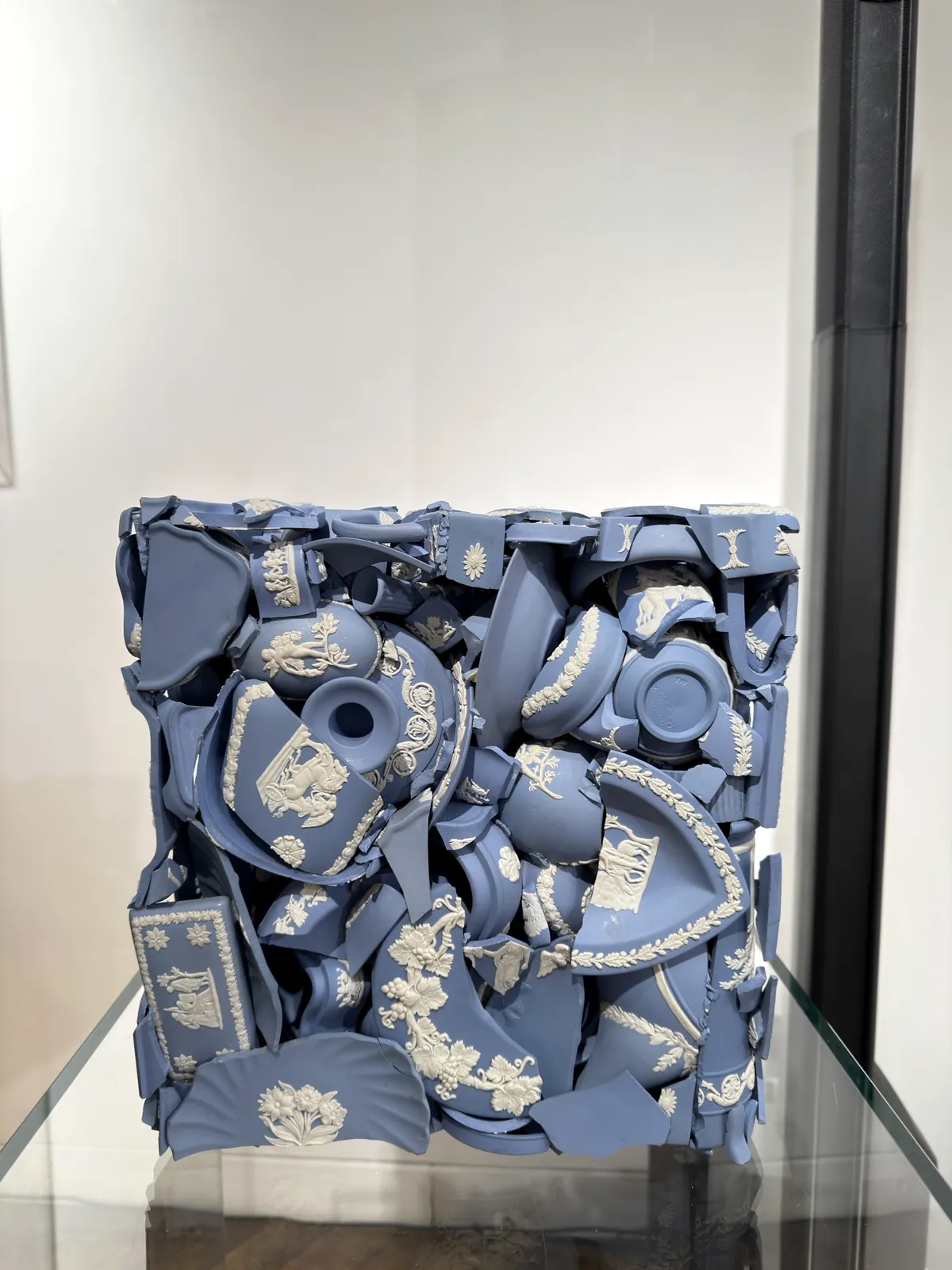
These work because the destruction is not decorative. English domestic porcelain is an object with a very specific social function — it is what a certain kind of household put out to signal that it was a certain kind of household — and breaking it and then rebuilding it into something you cannot drink from is an argument, not a surface. Three feet away, under gallery light, the argument lands.
One corner did not hold. It was a group of rugs carrying printed graphic designs. I grew up in a house where handwoven Persian carpets were ordinary furniture, silk among them, and I am not going to pretend that is a neutral eye. A hand-knotted carpet wears its making on its face: the knot count, the months, the small error you can find if you look for it. In front of these, what held my attention was the image, and it did not hold it long. That is a description of my attention, not of their manufacture — I did not ask how they were produced, and without that I have no business ruling on the work inside them. What I can say is that in a building whose strongest objects were about the labour behind an appearance, the image reached me immediately and whatever work stands behind it stayed out of view.
The table
In the middle of the evening the artists were sitting at a long table with pens, behind stacks of pre-printed works, signing. Not signing in the edition sense, which happens in a studio and is invisible. Signing to you: your name, a line of writing, the date, in front of you, while you waited.
Nothing at that table was for sale. The prints were free, given to anyone who asked for one, and inscribed on the spot. That inverts the obvious reading of the evening. Every object with a price on it — the porcelain, the metalwork, the canvases — was impersonal. The only thing in the building you could carry out for nothing was the one with your own name on it, in the maker's hand.
What the table buys is therefore not a sale on the night. It is a small debt of the kind that is never called in. You leave holding something you did not pay for, made specific to you by someone whose name is on the wall, and it goes up somewhere in your flat where it will go on saying the gallery's name for years. The marginal cost of that is a sheet of paper and ninety seconds of an artist's time. The gallery had found a way to make a print personal without having to claim it was unique — and then gave it away.
Set that against what this journal keeps finding in other rooms. The Proms sold certainty. Portsmouth sold comfort. Chelsea sold proximity. Here the most personal object in the building was the one nobody was charged for.
The artists did the other half of the work themselves. They talked about what they had made, at length, to anyone who asked, in plain language, without the defensive vagueness that tends to settle over an artist at an opening. Whether you rate the work or not, that is a real service — and it is the thing a great many rooms fail to provide to anyone who has not already been introduced.
What the room buys
It is easy, and lazy, to leave an evening like this calling it commercial. Everything on New Bond Street is commercial. The gallery with no labels is commercial. The difference is not whether money is in the room; it is what kind of money the room is arranged to take.
Here is the reading I left with, and I am offering it as a hypothesis, not a finding. One arrangement runs on scarcity: one work, one buyer, no price on the wall, restricted hours, an audience that arrives already knowing. It sells rarity, and rarity needs a narrow door. The other runs on access: editions, recognisable motifs, entry prices beside the large pieces, free signed prints, a bar, seven days a week until nine at night. It sells nearness to the thing, and nearness needs the door open.
The building complicates that immediately, which is exactly why it stays a hypothesis. The broken porcelain pieces are singular and not repeatable. The prints at the table are made to be repeated, and were given away. Both were in the same rooms on the same night, handled by the same people, for the same crowd. Whatever the model is here, it is not one of two boxes, and anyone who tells you the art world divides neatly into two is describing a diagram, not a street.
The pressure is real, though, and you can see it in the work. Scarcity rewards what is hard to repeat. Access rewards what survives repetition. Both effects were visible in this building on one evening: the porcelain at one end, and at the other the rugs, where the motif had become the whole product.
Art without money does die; that much is true and not worth arguing about. But money does not arrive as a neutral substance. It arrives with expectations attached, and what those expectations do to the work is the thing worth watching over the next few years. Not whether a room like this one is selling — everything on this street is selling — but what it is quietly teaching the people who make for it, and whether the visitor who went home with her name on a free print ever comes back for something harder.
EDEN, 103 New Bond Street, London. Opening night, Wednesday 14 October 2026. The gallery opens seven days a week, 9am to 9pm. Written and photographed by Reza Gheibi.
Note on sourcing: this is one evening, attended as a member of the public and not under press accreditation. No price list, checklist or interview was obtained, so titles, dates and dimensions are absent throughout and artist attributions are taken from the gallery's own wall text and plinth plates. The popcorn, the bar, the DJ, the live music, the signing table and the painting wall were the apparatus of an opening night, not of an ordinary weekday.