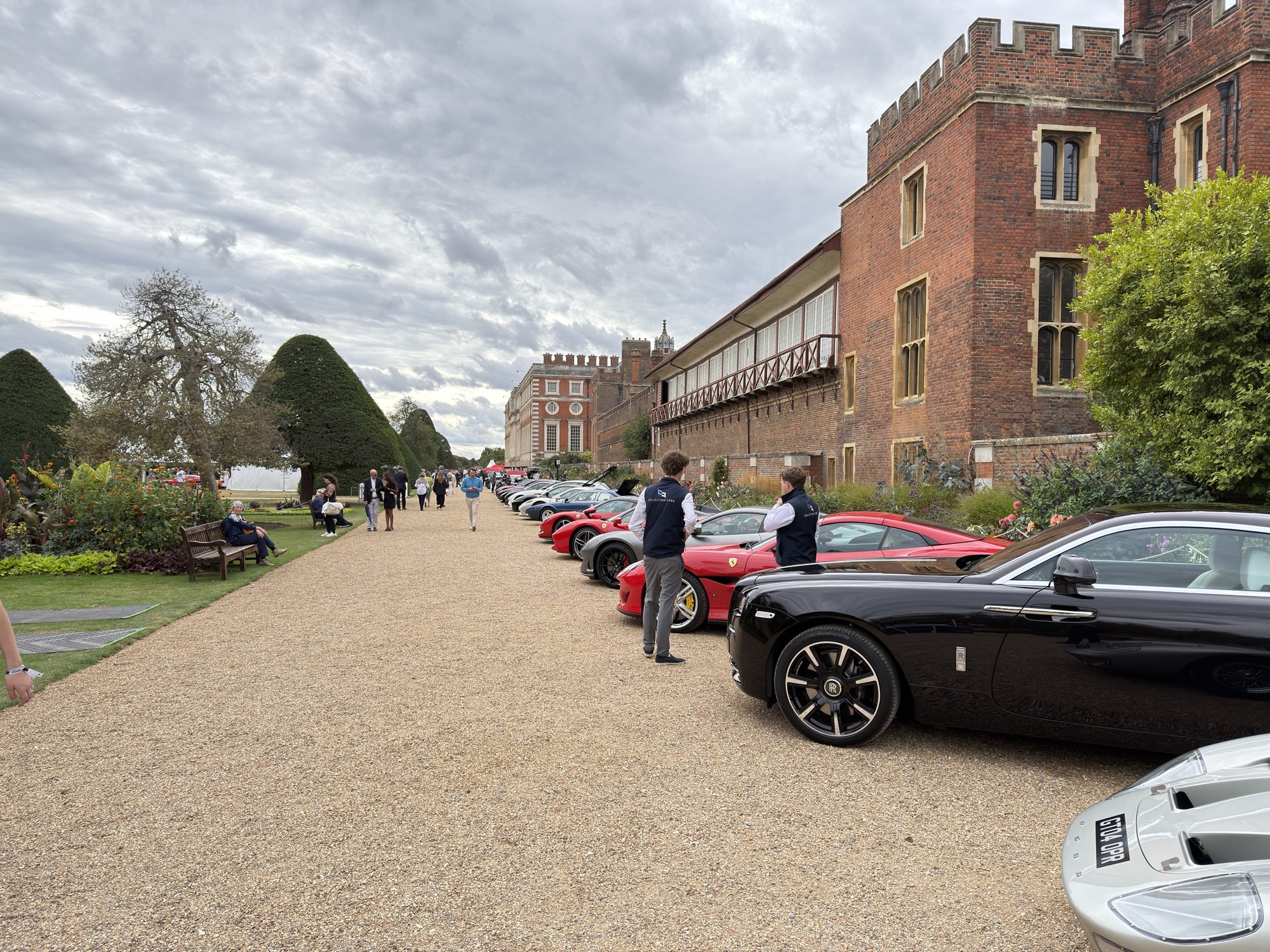
A Room Study from Hampton Court, where a VIP hospitality ticket bought comfort and social atmosphere — but the cars kept the authority.
I had bought the higher ticket this time. Other events had taught me a lesson: the more interesting room is often the one beside the event, not the event itself. At Hampton Court, that lesson failed.
I went to the Concours of Elegance on Friday 4 September 2026, alone, on a VIP hospitality ticket bought weeks in advance for more than £500. The expectation was ordinary enough — that a better ticket would not only make the day more comfortable, but bring me closer to where the event was most alive. It did the first thing. It did not do the second.
The grounds were already doing the work before the cars needed them: gravel paths, clipped trees, a long stretch of water, late-summer lawns, old brick, temporary white marquees under a heavy English sky. Hampton Court was not a neutral venue. Had the same cars stood inside a modern exhibition hall, many would have looked expensive. Here, they looked kept. An expensive object asks to be noticed. A kept object asks something quieter: that you understand the discipline required for it to remain itself.
What the ticket bought
The hospitality area had the signs of a fuller day — a private enclosure, food, drink, seating, service, a softer rhythm. People moved through it differently from the public grounds: slower, more social, more like people already familiar with being hosted. The clothes were more considered, the average age higher; many were there as much for conversation as for cars, using the room as a place where a conversation could happen without announcing itself as business.
That is a description, not a complaint. The room gathered people well. But it did not become the centre of the event. It bought comfort, food, service and atmosphere — a better-handled version of the day. What it did not buy, on this visit, was a privileged relationship with the thing that mattered most: the cars moving, being introduced, being heard in the palace grounds.
 Reza Gheibi
The room outside the room
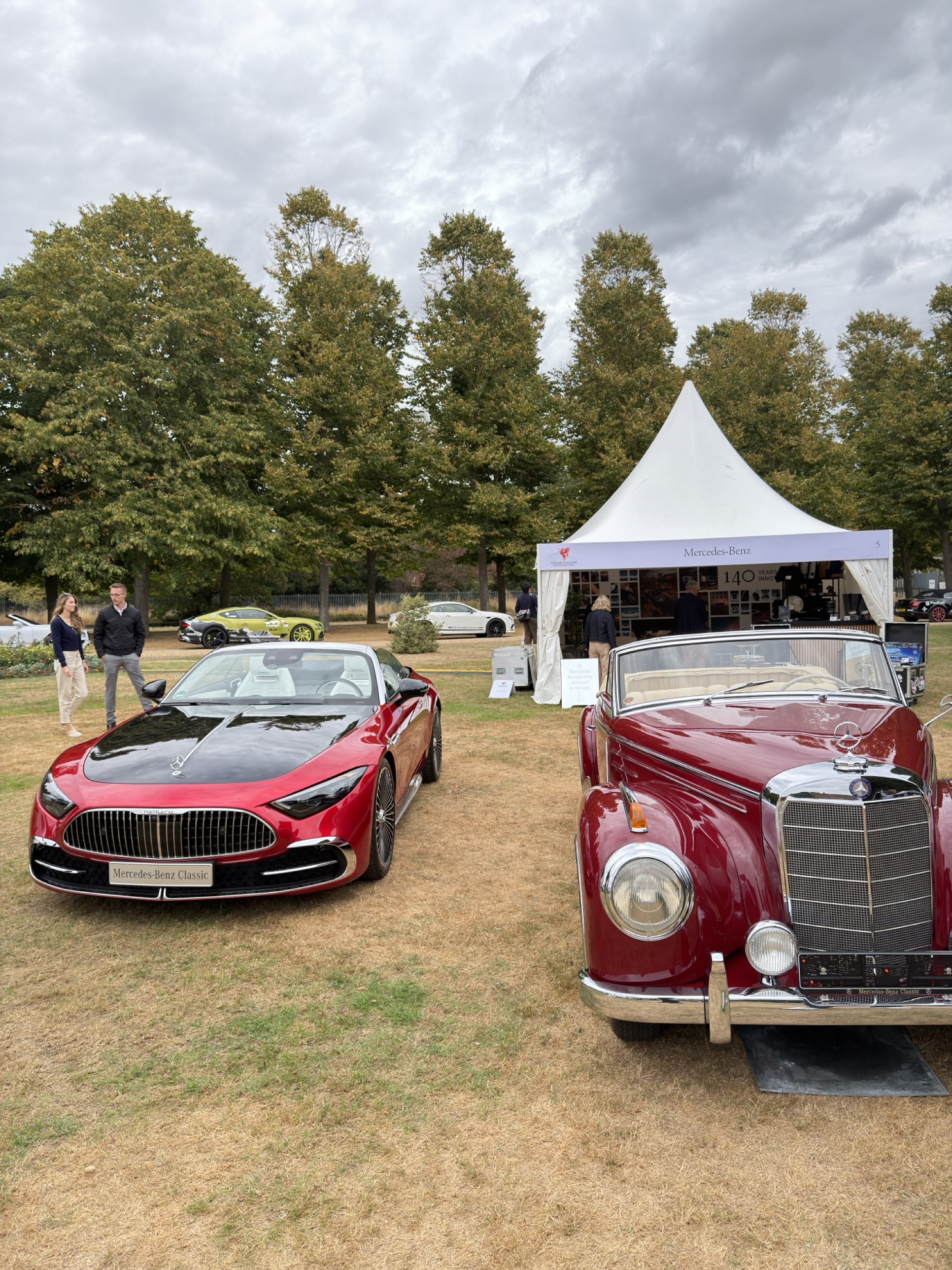
The strongest part of Hampton Court was not behind a wristband. It was outside, on the gravel and grass: the slow concentration of machines, engines starting or passing, owners standing near them, the stage where cars were introduced, the palace holding the arrangement in place without needing to explain it. That was the room. The lounge was beside it.
A classic Rolls-Royce did not need to perform. Its authority came from still being present in its own form, without being pushed into looking contemporary — the line of the body, the scale of the wheels, the weight of the paint. None of it felt nostalgic. It felt maintained. That word matters more than luxury here: maintained means time has not been denied, but managed.
 Reza Gheibi
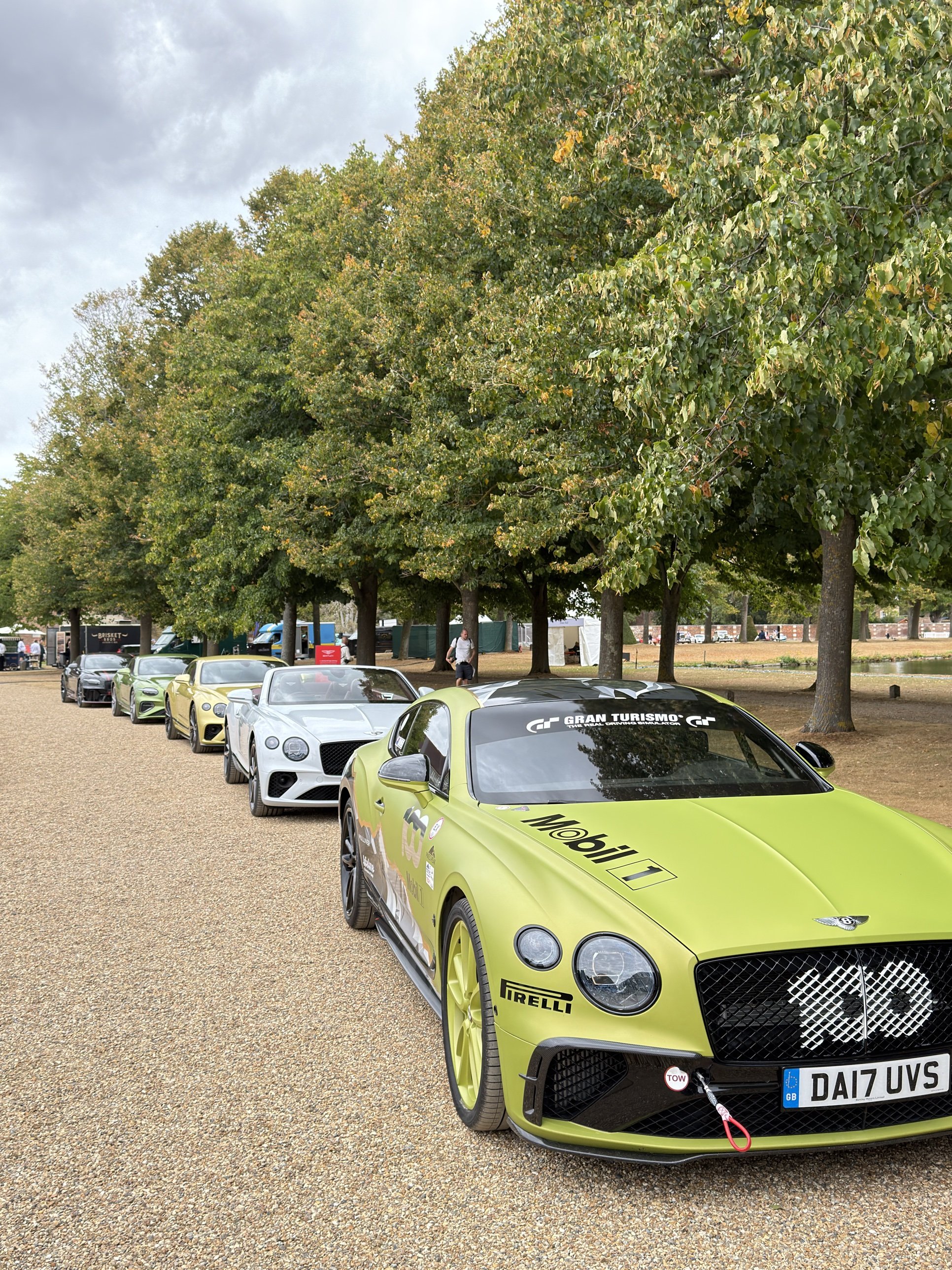
Nearby, newer performance cars produced a different energy — built for speed, surface, technical aggression. They were spectacular, but they did not cancel the older cars; they made the distinction clearer. One kind of car shows what engineering can still become. The other shows what craftsmanship can remain. The event worked because both could stand in the same garden without making the other irrelevant.
Owners, not just objects
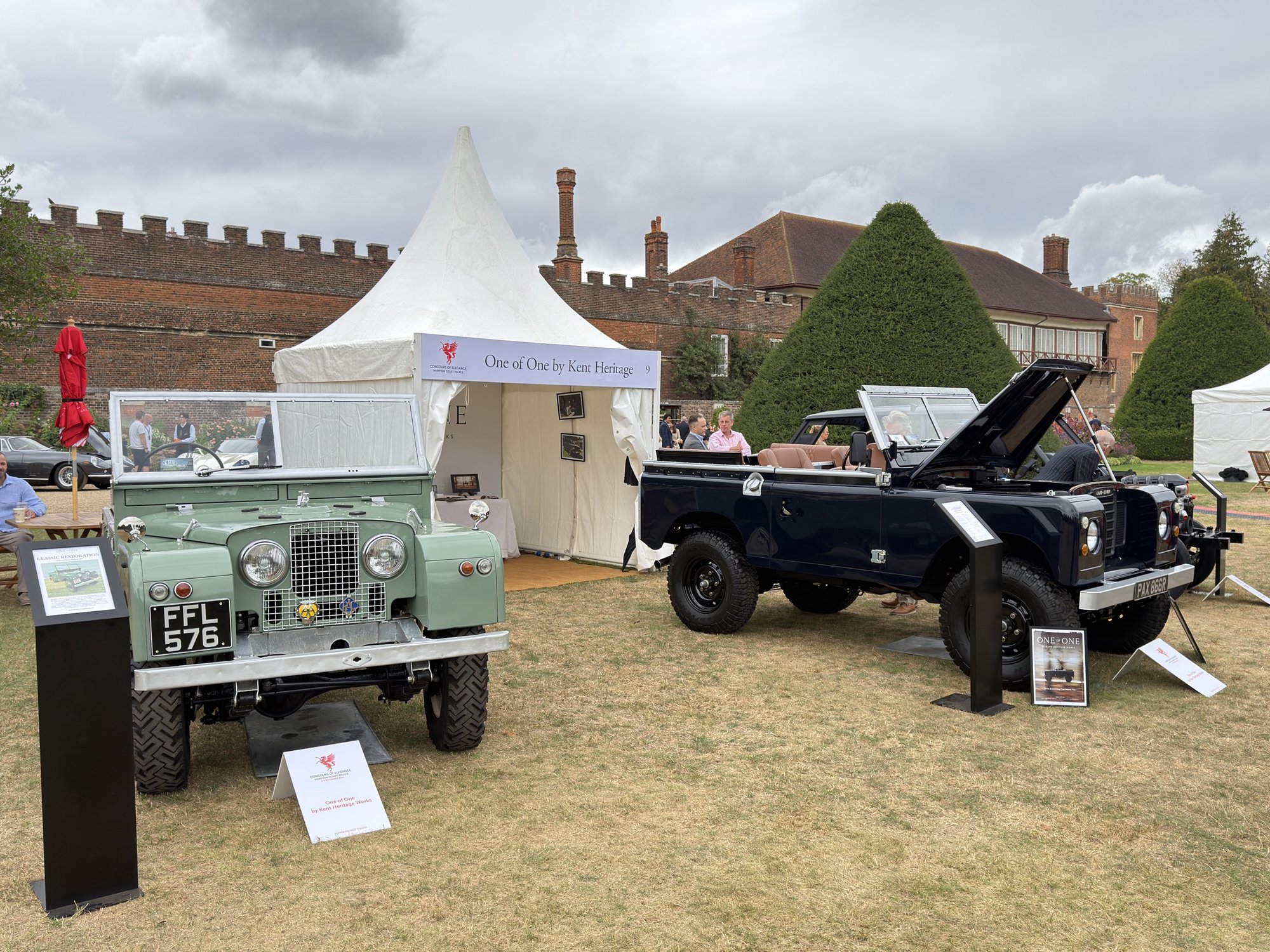
Some of the owners seemed to belong to the same language as the cars. This is delicate to say, because it slides easily into class theatre. That is not the point. What was visible was not simply wealth but a certain ease around preservation: the way people stood beside the cars, waited with them, allowed others to look, and did not need every object to become a spectacle. The cars and the people nearest them shared a grammar of custody. It did not feel like a rush toward novelty. It felt like an agreement that some things stay impressive because someone has carried them forward properly. Not frozen. Carried.
 Reza Gheibi
The sound mattered for the same reason. These were not museum objects under glass. Some moved; some were introduced; some were heard before they were fully seen. A car that can still move carries a different authority from one that has only survived as display. It has not merely been preserved. It has been kept available.
A Gulf room inside an English garden
The event’s surface was recognisably English — palace, gravel, lawns, weather, the restraint of people walking between rare machines without performing surprise. But inside that Englishness, another register appeared: a Bahrain-branded stand, Gulf Air visible, Arabic coffee, men in Gulf dress, advertising the Royal Bahrain Concours. It did not dominate. It sat inside the event, calmly, as if this language of hospitality already belonged there.
That belonging is not coincidence. The Concours of Elegance and the Royal Bahrain Concours are run by the same company — Thorough Events — as part of one international network that also stages events in Germany and London. So the “Gulf room” was not an organic cultural drift into an English garden; it was a sister event of the same organiser, introduced inside the first. That is the accurate version, and the more interesting one. The observation does not need to become a theory about Gulf money or intention. The smaller, firmer point is enough: the collector-car world staged in Britain is now run across more than one country, and it shows.
What VIP did not change
Much of the event still lived in the public grounds — the same cars, paths and lawns, the same food vans, the ordinary grammar of event catering. That did not damage the day; it clarified the difference between hospitality and authority. The official hospitality language promised a private marquee and a strong view of the cars, and the enclosure was refined. But the thing I wanted most was not a place to sit, eat or meet. I wanted a stronger position from which to read the event — the introductions, the movement, the stage, the cars becoming public again in front of an audience. That view often remained outside the enclosure.
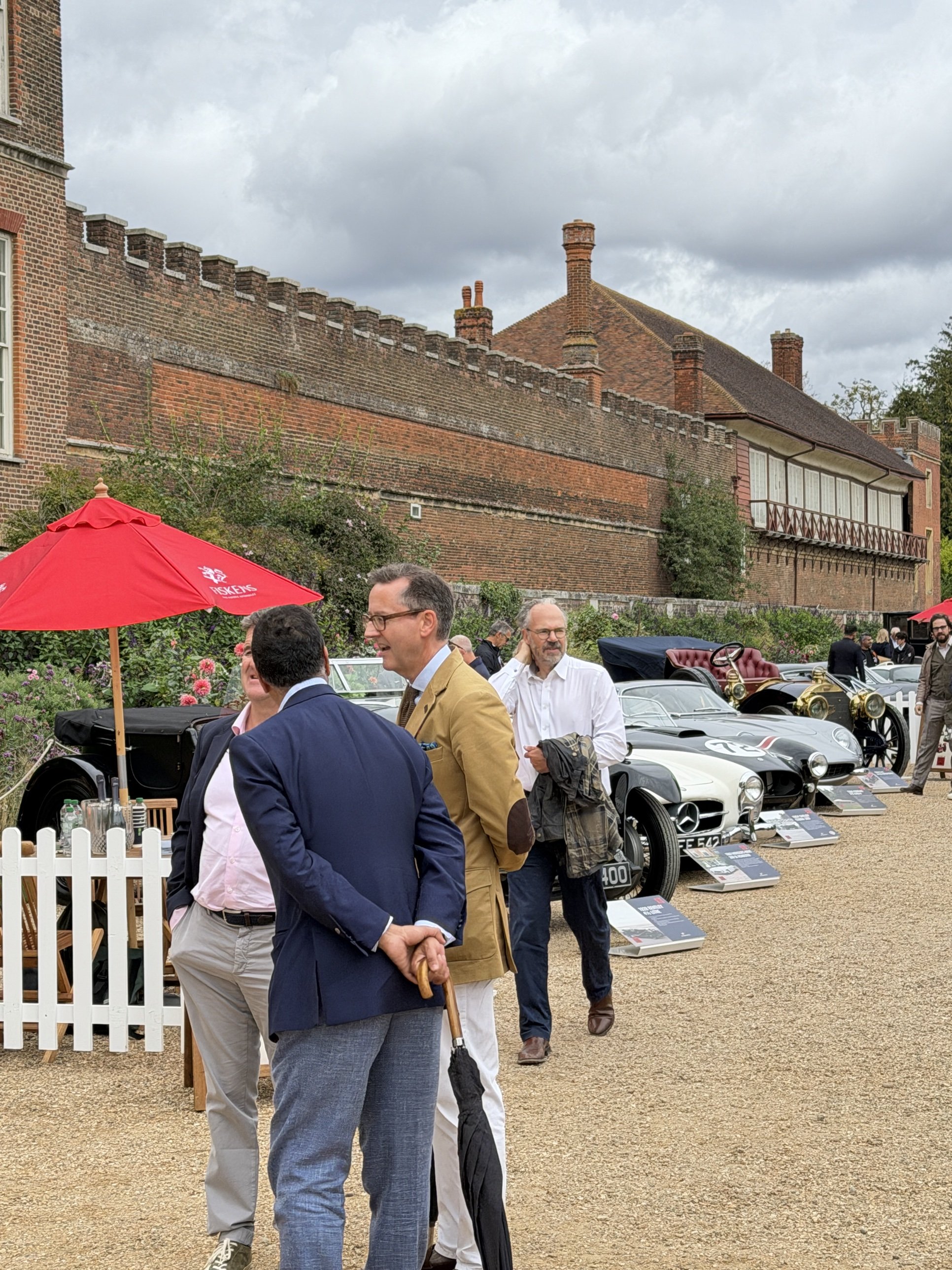 Reza Gheibi
So the regret was specific. I was not sorry to have attended, and the hospitality did not fail at hospitality. I was asking whether, for this event, hospitality was the right thing to buy. At Hampton Court, the answer was not obvious. A lounge can host people, feed them, shelter them and make them feel handled. It cannot automatically inherit the authority of the thing beside it. Here, the cars kept that authority for themselves.
Preservation as performance
The event’s strongest performance was not loud. It was the refusal of certain objects to become contemporary. The best cars were not trying to look new — that was their power. Their surfaces had been cared for without being made anonymous; their age was visible without looking neglected. This is why the palace mattered: it slowed the cars down enough to be read. In a convention centre the same machines might have become inventory. Here they became evidence of custody — someone had owned, protected, restored, financed, cleaned, transported and trusted them into public view. That is a cultural act disguised as automotive enthusiasm. The cars were not only rare; they were proof that rarity alone is not enough. What gave the strongest machines their presence was not scarcity, but the quality of care around them.
What became legible
Other ELIN Room Studies made access visible through objects: a ticket at the Proms, a wristband at Portsmouth, a lounge at Chelsea. Hampton Court complicated the pattern. Here the higher ticket did not reveal the centre. It revealed that the centre was somewhere else — not because the lounge was badly designed, but because the object of authority could not be moved indoors. The cars needed ground, distance, weather, light, movement and the palace around them. They needed to be approached, not viewed from a better seat.
Some events sell proximity. Some sell certainty. Some sell insulation from the crowd. Hampton Court’s VIP hospitality sold a composed social environment beside an event whose authority stayed stubbornly outside it. The hospitality did not create the meaning. It borrowed from it. And because the core event was strong, that borrowing did not spoil the day — it simply showed the limit of what hospitality can do.
Sold, bought, unavailable
Sold. A Friday VIP hospitality ticket to the Concours of Elegance at Hampton Court Palace, bought in advance for more than £500, within a tier publicly described as including private marquee access, food, a Champagne reception, afternoon tea and a souvenir catalogue.
Bought. A lounge, catering, shelter, a more composed social environment, a place to meet and return to, and the feeling of being hosted rather than simply admitted.
Unavailable. A materially stronger claim on the centre of the event. The day’s real authority — the cars, their sound, their movement, their owners, their placement inside Hampton Court’s gardens — stayed mostly outside what the hospitality tier could confer.
How we know
This is a first-person account of a Friday visit to the Concours of Elegance at Hampton Court Palace on 4 September 2026. The observations — the hospitality area, the audience, the Bahrain-branded stand and Gulf Air visibility, the Arabic coffee, the cars, owners, stage presentations, grounds and gardens, and the author’s disappointment with the relationship between hospitality and access — are based on the author’s own attendance and photographs taken on site.
The dates, venue and the description of the Concours of Elegance as a three-day gathering of around sixty of the world’s rarest cars in the Fountain Garden are taken from Historic Royal Palaces and the organiser’s published material. The Friday hospitality tier and its £500 price and inclusions are described on the organiser’s own site; the figure here is the price paid by the author, inclusive of booking fees.
That the Concours of Elegance and the Royal Bahrain Concours are run by the same organiser, Thorough Events, as part of one international concours network, is taken from the Concours of Elegance’s own material and the Royal Bahrain Concours. What individual guests paid, what was said inside the hospitality areas, and what strategic aims sat behind any partner presence, remain open.
Disclosure. ELIN attended independently. The ticket was bought by the author. The author had no media accreditation, complimentary access, sponsorship, hospitality invitation, client relationship or employment with the Concours of Elegance, Historic Royal Palaces, Gulf Air, Royal Bahrain Concours, Thorough Events, or any exhibitors or owners mentioned.