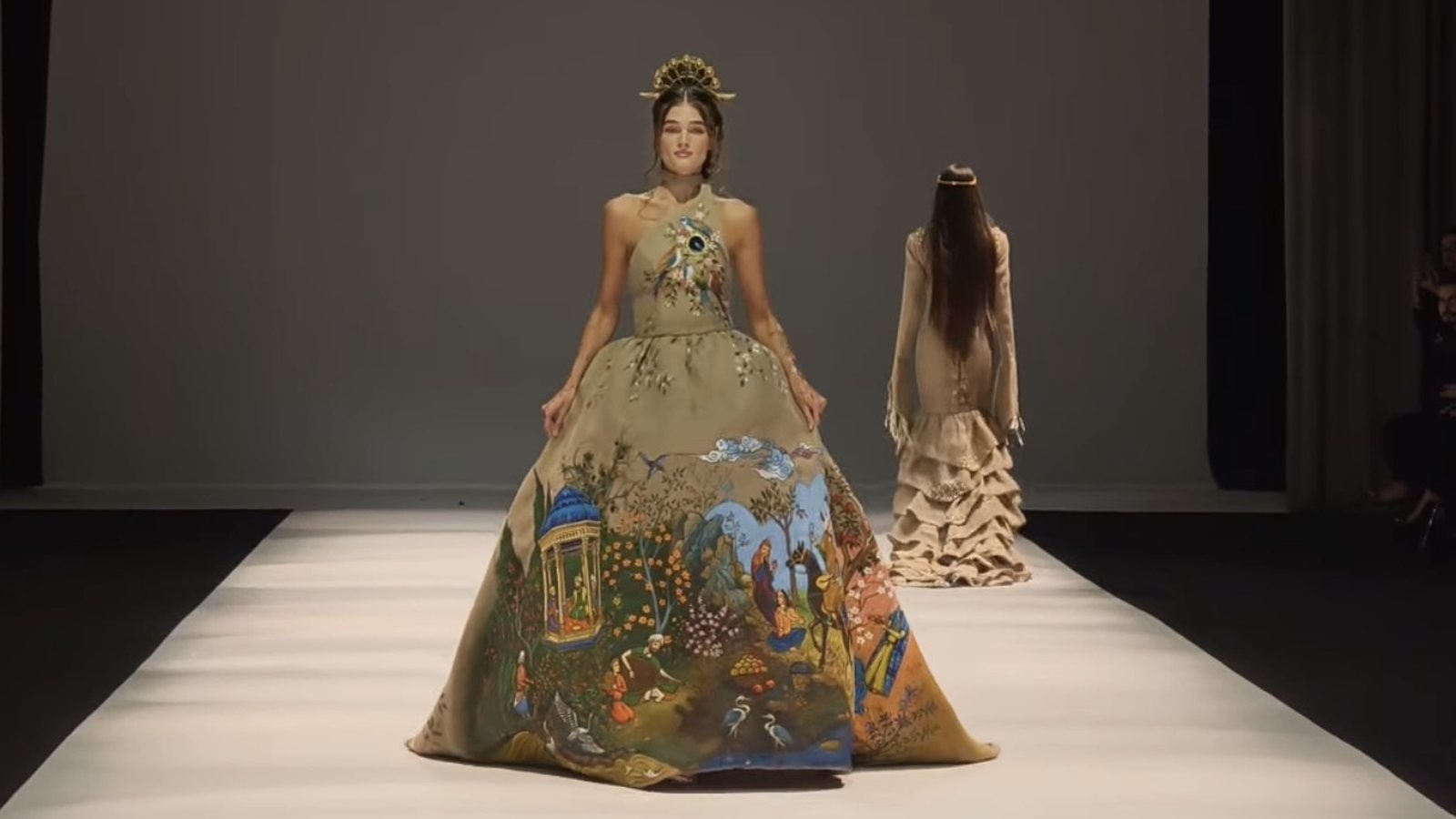
ELIN reads Sara Pedram's Simorgh Collection at Dubai Fashion Week: a designer moving Persian myth and miniature painting through couture — strongest where the cloth carries the story, weakest where embellishment takes over.
Sara Pedram named her Dubai collection after the Simorgh, the great bird of Persian myth — the one the birds of the world cross seven valleys to reach, only to find it in themselves. The clothes reach for that story. The question a runway cannot dodge is whether the garment carries the myth, or merely wears its name.
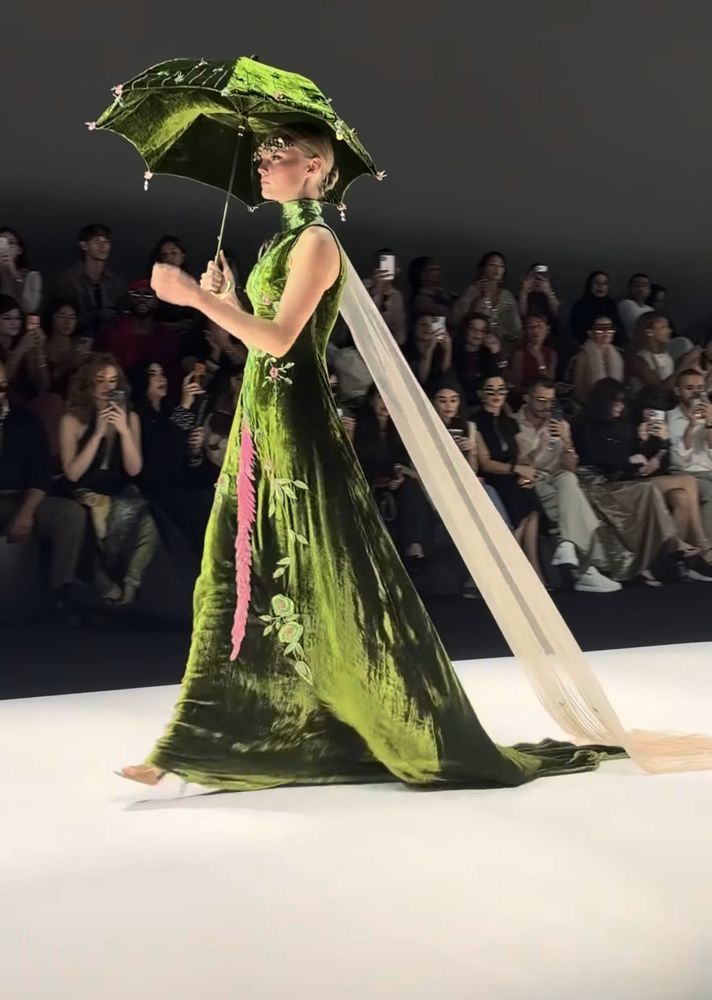
A model comes down the runway beneath a green velvet parasol. On the skirt behind her a Persian garden has been painted in full — peacocks, a tiled pavilion, a tree, small figures at their business. This is the Dubai Design District, not a miniature gallery, and for a moment the distinction thins.
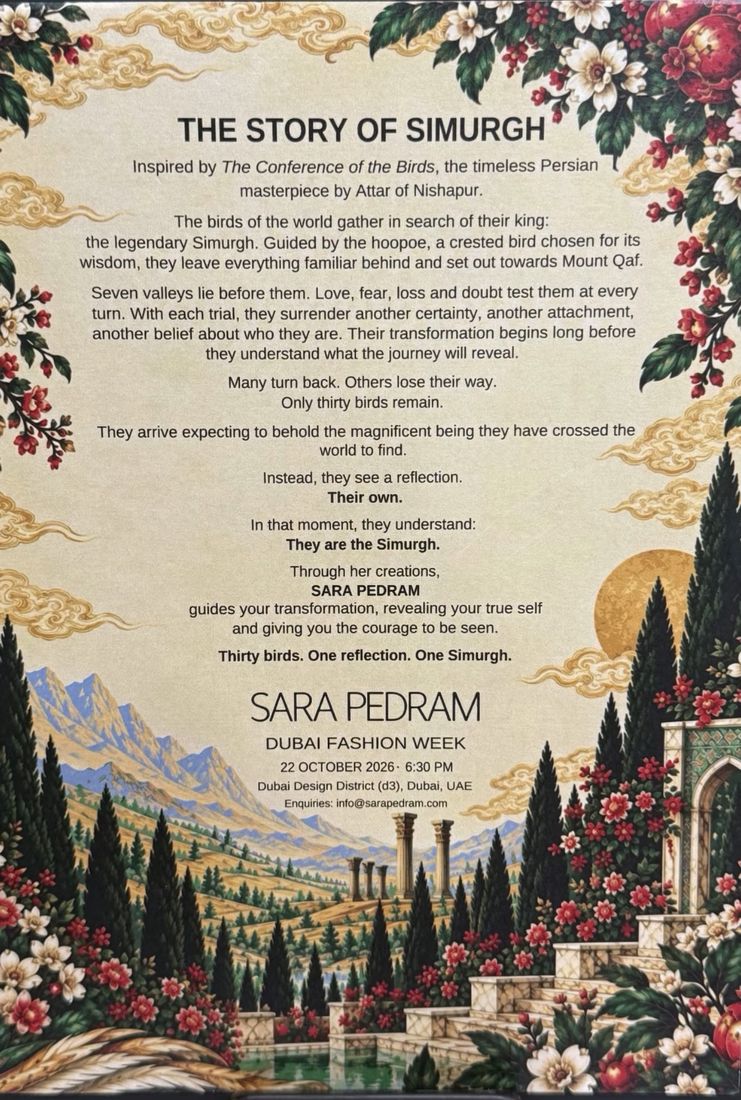
The invitation set the terms before a single look appeared. The Story of Simurgh, after Attar of Nishapur: a journey through seven valleys, each trial shedding another certainty, until the birds who survive the journey arrive expecting a king and see, instead, their own reflection. Through her creations, the card promised, Sara Pedram “guides your transformation.” It is a large claim to pin to cloth, and worth holding the clothes to.
The stage
Arab Fashion Week is Dubai Fashion Week now. The name widened in 2023 and the frame with it: from a showcase of Arab designers to a market that wants the region and the world in one room. The calendar has moved to October, nearer the buying cycles and the Ramadan collections. This season designers came from India, Colombia, France, Vietnam and Ukraine, most from outside the Emirates. The opportunity is plain — Dubai can put a designer in front of buyers across several markets at once. The risk is just as plain: the more international the room, the more easily a regional voice blurs into it.
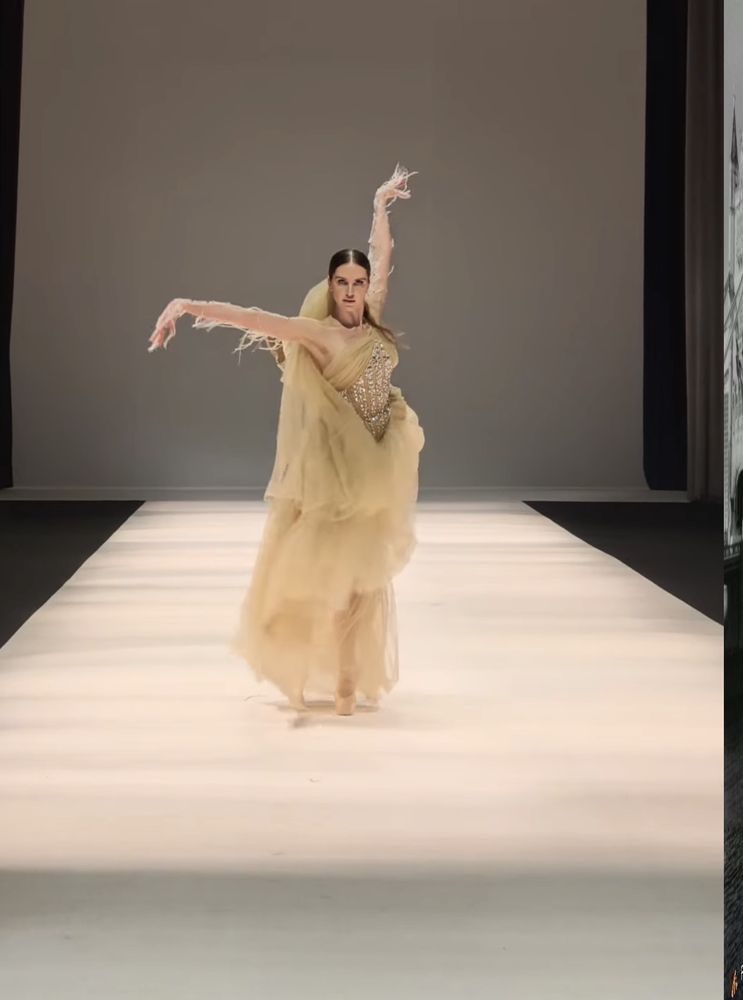
Pedram, self-taught and Dubai-based, opened one of four couture shows on the first night, alongside Yousef Al Jasmi, Pallavi Puri and Kresha Bajaj. The show began not with a garment but with a ballerina.
What the cloth carries
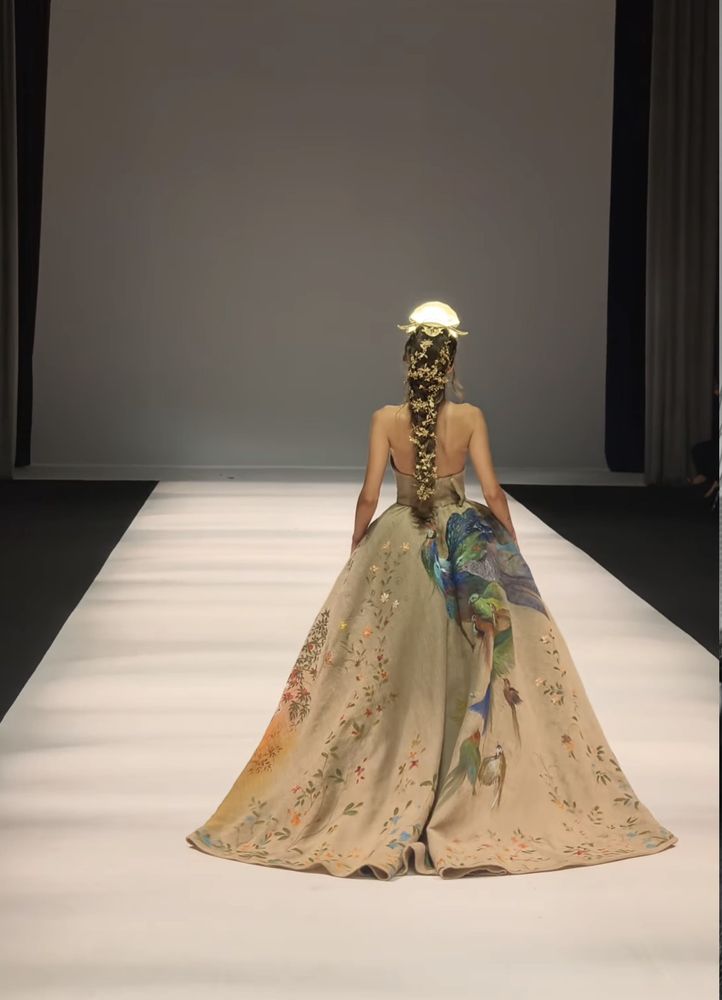
The collection is strongest where the reference lives in the cloth itself, not beside it. The best of these is a full-skirted gown hand-painted, on rough hessian, with a garden: peacocks and birds, a tiled pavilion, figures — a compressed landscape in the language of Persian miniature painting, in a scene the house traces to Hafez. Painting an exalted poetic world onto humble sackcloth is an idea, not only a surface, and it is the single most convincing meeting of art and dress in the room. The critic for The National singled out this gown as the show's “most arresting” look.
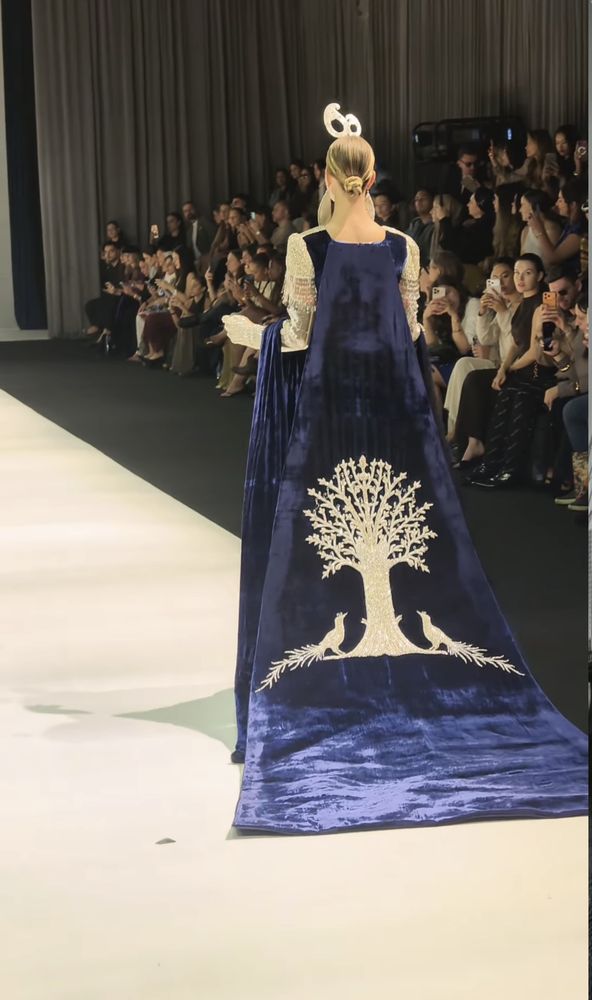
The second is a Prussian-blue velvet gown whose train carries a Tree of Life picked out in Swarovski crystal, two birds at its foot. Here the back, not the front, is the event: the tree and the pair of birds, which we read as the Simorgh itself. The motif gives the garment a centre and rewards the viewer from behind as much as from the front. The third is the green velvet gown and its matching parasol, a long cream chiffon train trailing behind: controlled theatre, the garden carried into movement.
In all three the craft is real — hand-painting, embroidery, built volume. This is what it means for art to become fashion, rather than to be, in the tired phrase, “Persian-inspired.”
Where the claim outruns the cloth
Pedram sets the bar herself. “Fashion is more than a beautiful dress,” she has said, and that she likes to explain the story behind each piece. Measured against her own intention, the clothes keep the promise only in part.
Attar's story is about letting go. The birds shed everything, grow lighter, surrender their certainties. The clothes move the other way — full, heavy, worked to the edge. The poem's subject is renunciation; the runway's experience is accumulation and spectacle. Even the garden gown, for all its force, is crowded: the painting fills almost the whole skirt, with no quiet space to let it settle, and at moments the dress reads as a moving picture more than a silhouette. The velvet gowns make a commanding entrance, but their weight swallows the body; the broad volume turns the look toward ceremony, and the woman inside it nearly disappears.
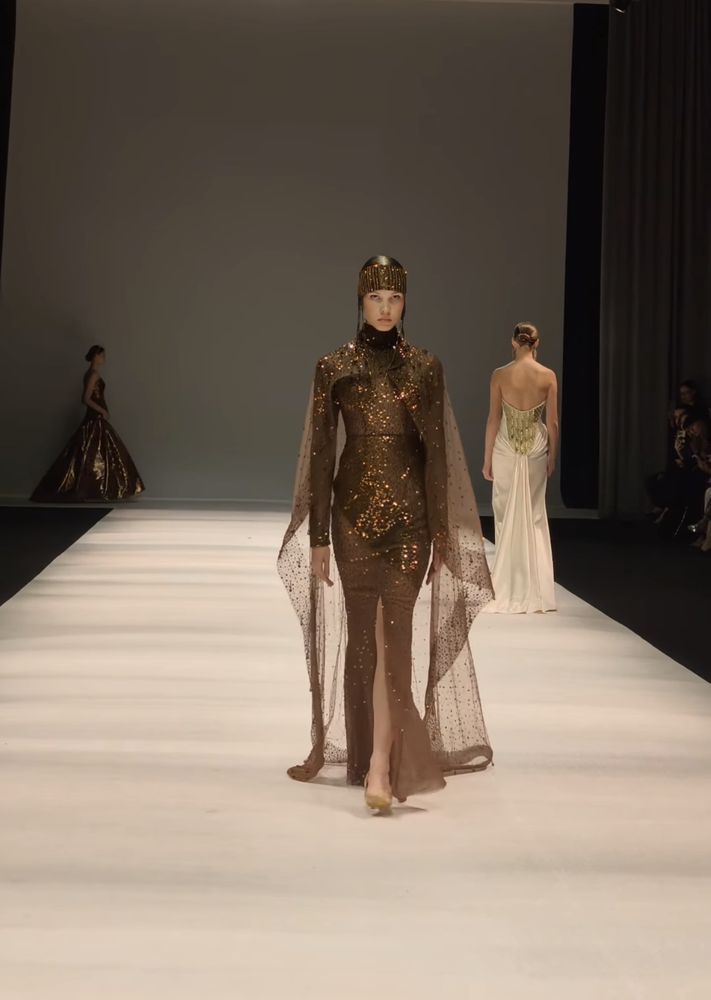
The weaker looks fall back on the common tongue of eveningwear. A gold column gown leans on familiar codes — metallic cloth, a beaded headpiece — and lets decoration, not cut or construction, carry the meaning. A brown, star-dotted gown under a shimmering cape is polished, and could belong to any house on any runway. When ornament does all the work, the Simorgh goes quiet.
There is a tell worth recording. Not every reviewer even registered the myth: one read the show simply as nature-inspired fantasy, all botanical pattern and romance. When the literary programme does not reach the eye, the fault is usually the garment's, not the viewer's.
Two that point the way
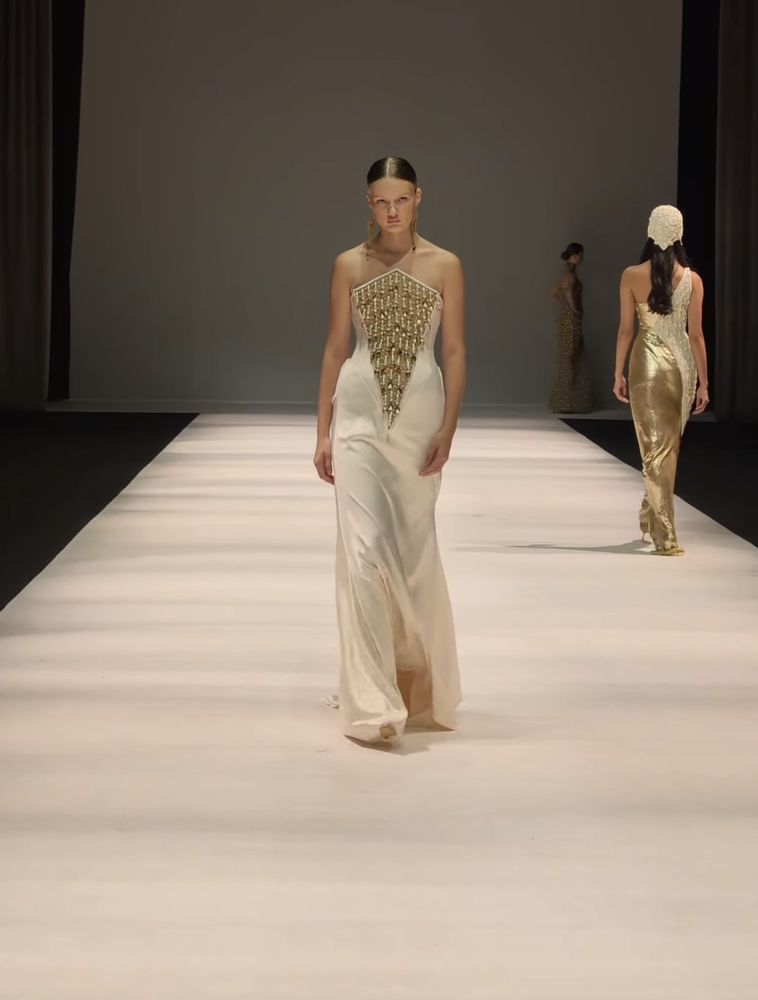
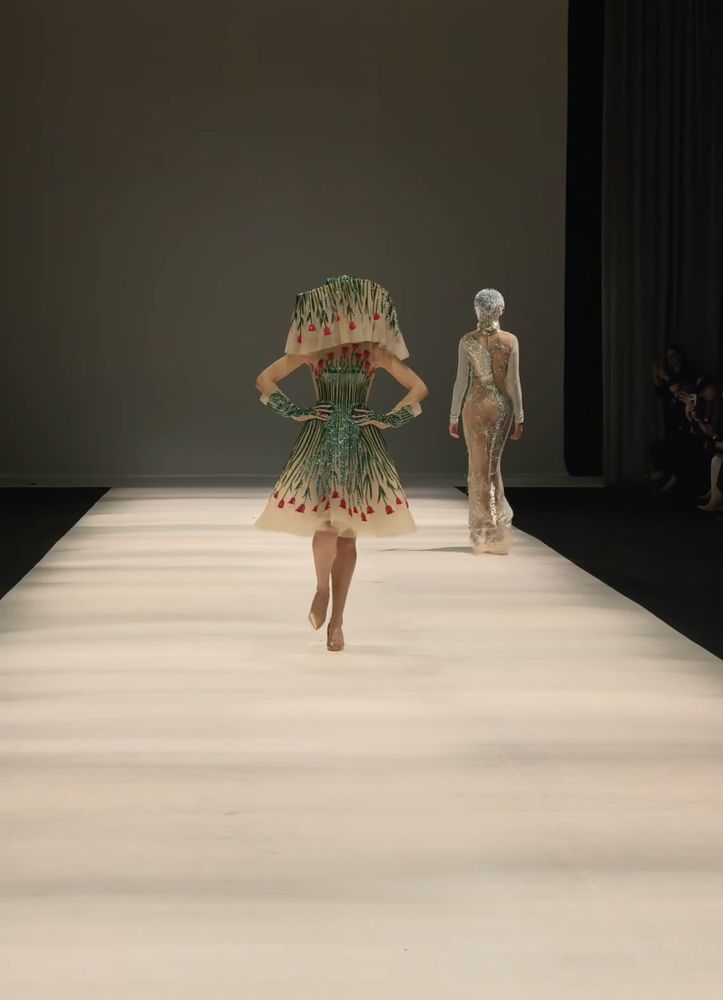
Two looks show the discipline the rest wants. An ivory bias-cut gown carries a single triangular field of gold beadwork at the bust; the ornament has one focus, and the plain shape lets the surface speak. A short dress of embroidered reeds and red tulips, under a sculptural collar, has invention and restraint at once — a fresh idea without the clutter. Between them they mark the distance the collection has yet to hold steady: between a garment that thinks and one that only decorates.
After the runway
What Pedram is attempting is rarer than it looks, and more interesting than “Persian decoration”: moving a literary and visual inheritance through the body of contemporary couture. That a self-taught designer is doing it at all is part of what makes the work worth watching. Two or three pieces — the garden, the tree, the parasol — are the collection's own argument. It would be stronger with a sharper hierarchy and more variety of silhouette, so the central idea has room to breathe; as it stands, the luminous pieces sit beside the crowded and the conventional with no line drawn between them.
The harder test comes after the runway. The strongest looks give Persian storytelling a physical form — painted cloth, embroidered symbols, a silhouette that holds the image. Elsewhere, embellishment takes over, and the challenge is to make the story inseparable from the garment. In Attar's poem the Simorgh is what the travellers become by crossing the distance to it; here that distance is the one between a picture and a design language, and Pedram has made the crossing two or three times, with the rest of it still ahead of her.
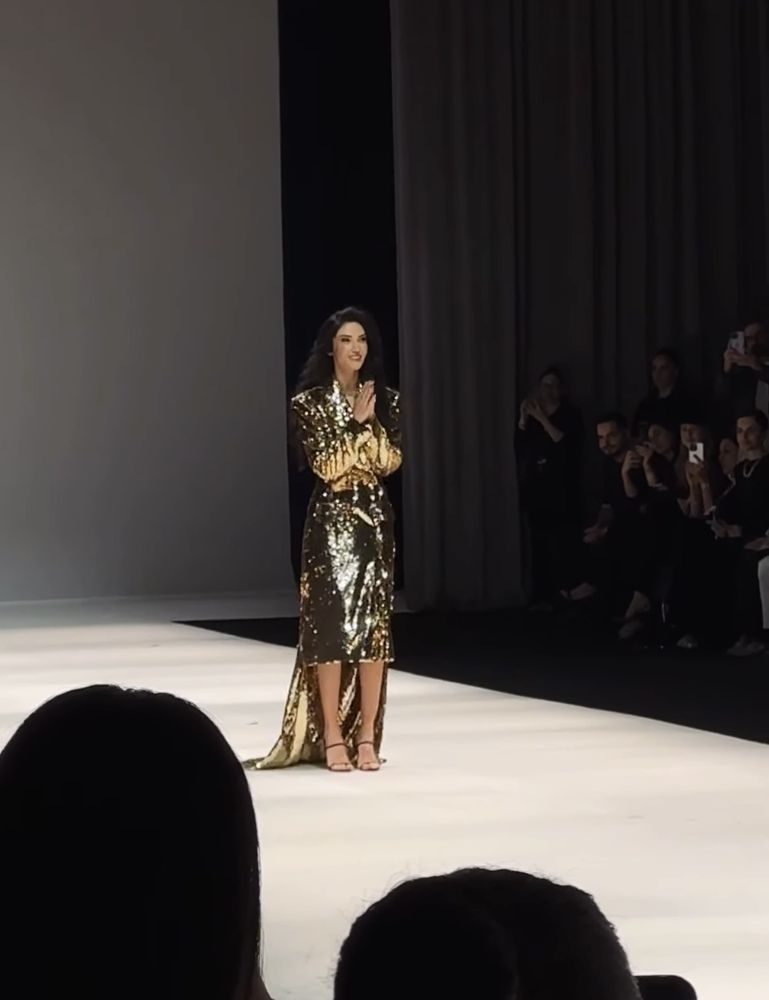
Sara Pedram, The Simorgh Collection, Dubai Fashion Week SS27, Dubai Design District (d3), 22 October 2026. Written and photographed by Ailin Gheibi.
Note on sourcing: the show was attended in person, and the descriptions and photographs are the writer's own. Exhibition detail and the designer's quoted words are drawn from The National (Sarah Maisey, 23 October 2026); the reading of the show as nature-inspired fantasy is from Emirates Woman (23 October 2026). The spelling “Simurgh” follows the invitation; “Simorgh” is used throughout for the bird.